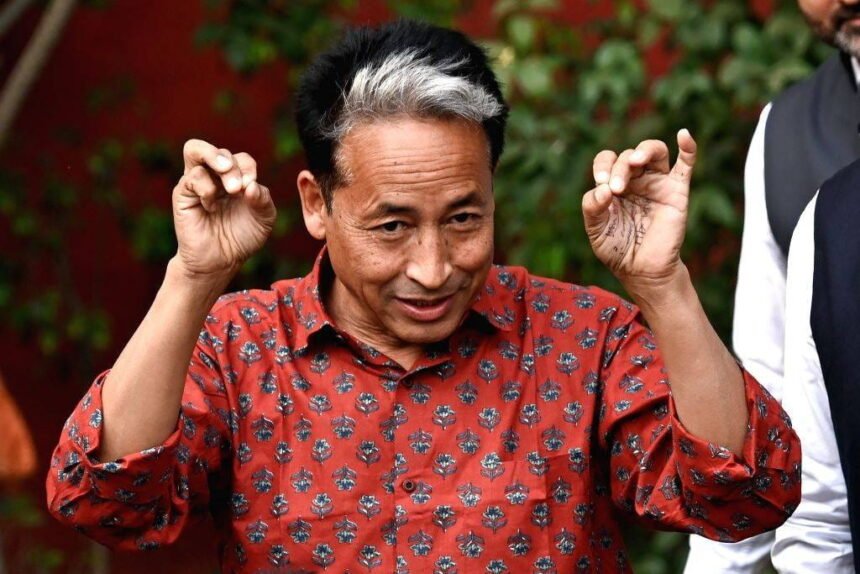
On Saturday morning, the Delhi Police took activist Sonam Wangchuk, who had been on a hunger strike at Jantar Mantar in New Delhi for the past 20 days, to the hospital for “necessary medical care.”
Sonam Wangchuk has been part of the ‘Cockroach Janata Party‘ protest, which demands major reforms to the examination system and the resignation of Union Education Minister Dharmendra Pradhan following paper leaks in several exams. Let us explore how activism has played a pivotal role in Wangchuk’s life, dating back to his childhood when his father undertook a hunger strike and how this teacher and innovator became involved in politics.
Sonam Wangchuk is a multifaceted Indian engineer, innovator, and activist who has dedicated his life to the sustainable development of Ladakh’s Trans-Himalayan region. His commitment to grassroots reform and environmental stewardship has made him one of the most influential voices for mountain communities in India.
Sonam Wangchuk: Early Life and Educational Foundations
Born in 1966 in the Leh district, Sonam Wangchuk spent his early years amidst the challenges of a remote region where essential educational facilities were scarce. He did not attend a formal school until the age of nine; instead, he received his initial education from his mother in his native language. His experiences with a traditional and alienating education system, where language barriers often made him feel like an outsider, fueled his lifelong passion for educational reform.
He subsequently earned a degree in Mechanical Engineering from the National Institute of Technology, Srinagar, and later specialised in ‘Earth Architecture’ (the art of building with earth) in Grenoble, France.
Transforming Education: The SECMOL Era
In 1988, shortly after graduating, Wangchuk co-founded the ‘Students’ Educational and Cultural Movement of Ladakh’ (SECMOL).
A) Operation New Hope: Launched in 1994, this initiative was a crucial collaboration between the government, local rural communities, and civil society aimed at completely transforming the regional school system. Through teacher training and the development of locally relevant textbooks, the Class 10 pass rate rose from a dismal 5% to over 75%.
B) Alternative Education: Wangchuk established the SECMOL campus, an alternative boarding school that serves as a ‘living laboratory’ for sustainable living. Renowned for its ‘passive-solar architecture,’ this campus maintains a comfortable indoor temperature without the use of any fossil fuels, even during Ladakh’s freezing winters.
Environmental Innovation: The Ice Stupa
Sonam Wangchuk’s most internationally renowned contribution to environmental science is the ‘Ice Stupa’. He observed that glaciers were melting prematurely due to climate change, thereby jeopardising the water supply for farmers in Ladakh. To address this, he devised a simple yet brilliant solution:
A) The Concept: Using gravity-fed pipes, flowing winter water is directed into a conical structure. This shape minimises the surface area exposed to sunlight, allowing the water to remain frozen as an “artificial glacier” until the dry spring months; as it melts, it provides the water essential for agriculture.
B) Global Recognition: For this invention, he received the prestigious ‘Rolex Award for Enterprise’ in 2016 and the ‘Ramon Magsaysay Award’ in 2018.
Political Advocacy and Grassroots Activism
In recent years, Wangchuk has emerged as a prominent political activist, focusing on protecting Ladakh’s fragile ecology and cultural identity.
A) Demands for the Sixth Schedule: A key aspect of his recent activism is the demand to bring Ladakh under the Sixth Schedule of the Indian Constitution. This would grant the region greater autonomy to safeguard its land, environment, and indigenous culture.
B) Methods of Protest: Wangchuk has frequently resorted to “climate fasts” and prolonged hunger strikes to draw national attention to these issues. His protests have linked regional concerns to broader national debates regarding environmental policy, constitutional safeguards, and governance.
“In the future, defense is unlikely to mean India amassing weapons against China, or China against the US… Do we not need to invest in establishing peace with nature? For this, must we not redesign our education system in a way that benefits the Earth and the people who inhabit it?”- Sonam Wangchuk
Also Read: Taslima Nasrin Set to Return to Kolkata After Two Decades; Controversy Erupts