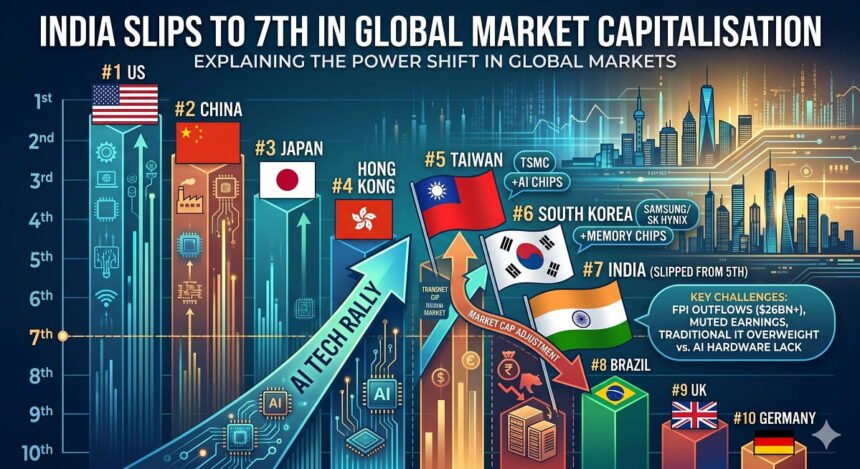
The news that India has slipped to seventh in the global market capitalisation (market cap) rankings signals a significant shift in the global investment landscape. Until very recently, India had firmly secured its place as the world’s fifth-largest stock market.
However, due to the rapid diversion of global capital toward other avenues, both Taiwan and South Korea have surpassed India, causing the country to slide down the rankings. To put this into clearer perspective, India’s total market value stands at approximately $4.85 trillion, trailing behind South Korea and Taiwan, both of which have crossed the $5 trillion mark.
Why Did India Lag Behind?
This shift did not occur because Indian businesses suddenly ground to a halt; rather, it was a “perfect storm”, a convergence of multiple factors, arising from global trends and structural disparities within the assets currently being acquired by investors.
1. The Global AI Boom (The Primary Cause)
The principal driver behind this shift in rankings is a massive and sustained global surge in investment in Artificial Intelligence (AI). Global investors are increasingly favouring technology-centric markets that develop the physical infrastructure associated with AI.
Taiwan and South Korea: These markets are dominated by major hardware companies. Taiwan is home to TSMC (the world’s largest contract chip manufacturer), while South Korea hosts Samsung Electronics and SK Hynix (leaders in high-bandwidth memory chips essential for AI processing). Recently, their stock indices have surged anywhere from 60% to over 100%, as they sit at the very epicenter of the AI supply chain.
India: India’s tech sector relies primarily on traditional IT services (such as TCS, Infosys, and Wipro). Since these companies focus more on software maintenance and consulting rather than manufacturing AI hardware, global funds perceive them as lagging behind in the current AI race—a perception that has adversely impacted Indian IT stocks.
2. Large-scale Withdrawals by Foreign Investors (FPIs)
Foreign Portfolio Investors are withdrawing capital from the Indian equity market at an unprecedented rate. So far, driven by this capital outflow, foreign investors have pulled out over $26 billion from Dalal Street, a figure that has easily surpassed previous annual withdrawal records.
Global funds have engaged in massive selling of Indian equities with the objective of booking profits, and have directly reinvested that capital into AI-based technology sectors in Taiwan, South Korea, and the United States.
3. Sluggish Corporate Earnings and High Valuations
For the past few years, Indian equities have been trading at a premium, implying that they were significantly more expensive compared to other emerging markets. However, the pace of corporate earnings growth for ‘India Inc.’ slowed down, dropping to single-digit levels (approximately 5% to 6%). As earnings growth decelerated, foreign investors found it increasingly difficult to justify the high share prices, which subsequently triggered a market correction.
4. Macroeconomic and Currency-Related Pressures
External factors, such as geopolitical tensions in West Asia and volatility in crude oil prices, have continued to exert pressure on India’s import bill. This situation has led to a depreciation of the Rupee against the US Dollar. Since global market capitalisation is calculated in USD, a weakening of the domestic currency automatically results in a decline in the market’s total value on the global leaderboard.
Global Market Cap Top 7 Rankings
The broad picture of the world’s largest equity markets currently looks something like this:
| Rank | Country | Key Market Characteristic |
| 1 | United States | Global tech hegemony (Nvidia, Apple, Microsoft) |
| 2 | China | Massive manufacturing and state-backed enterprises |
| 3 | Japan | Automotive, robotics, and steady corporate governance reforms |
| 4 | Hong Kong | Gateway financial hub for mainland Chinese capital |
| 5 | Taiwan | Semiconductor capital of the world (TSMC) |
| 6 | South Korea | Memory chip and electronics powerhouse (Samsung, SK Hynix) |
| 7 | India | Consumer discretionary, banking, and traditional IT services |
Global Market: A Ray of Hope
Financial analysts point out that this phase of consolidation has brought about a moderation in those segments of the Indian market where valuations had become excessive. With large-cap valuations reverting to their long-term historical averages, a favorable entry opportunity is emerging for patient, long-term investors. Furthermore, the fundamentals of India’s core economic growth remain robust, and the economy is projected to expand at a solid pace of over 6% this year.
Also Read: Online Negativity Can Exacerbate Mental Distress – Research Warns