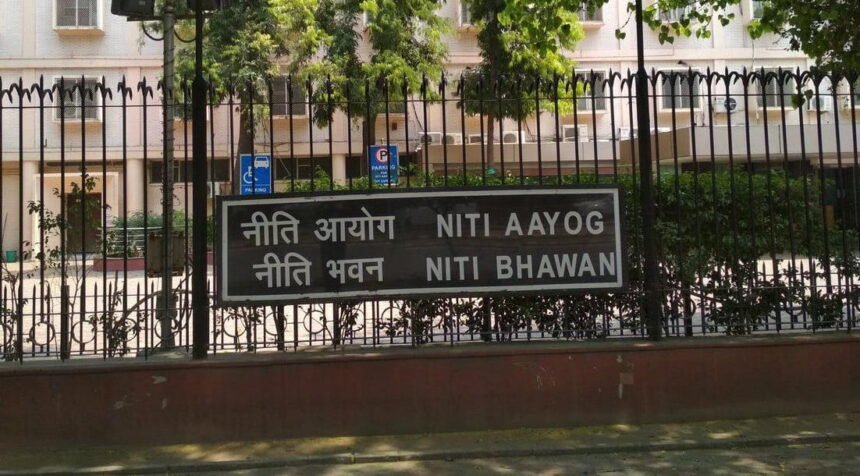
According to the NITI Aayog report titled ‘Reimagining Skilling for Viksit Bharat@2047’, approximately 87 million Indians aged 15 to 29 were neither studying, working, nor undergoing any training in 2021. This figure highlights a significant segment of the youth population that is not transitioning directly from education to employment or skill development.
Based on data from the 78th round of the National Sample Survey, the report identifies this group as Not in Education, Employment, or Training (NEET) youth, a category that includes the unemployed. NITI Aayog stated that this group, along with women, requires affordable or subsidised training and financial assistance; furthermore, skilling programs should be aligned with local demand, self-employment opportunities, and emerging sectors.
The report also expresses concern over the weak link between formal education and employment. It notes that only 8.25 percent of graduates are employed in roles commensurate with their qualifications. A lack of practical experience and industry-relevant training impacts the employability of even those who have received formal education.
The report highlights that students from low-income families often cannot afford the costs of additional paid skilling programs alongside college fees and private tuition. After graduation, some opt for jobs that offer a stable income, even if low-paying, while others struggle to enter the workforce and end up in the NEET category.

For Classes 10 and 12, NITI Aayog has recommended integrating vocational subjects into the board curriculum
The report points out that currently, vocational subjects are taught in fewer than one in twelve secondary schools, despite provisions in the National Education Policy 2020 and the National Curriculum Framework to increasingly integrate vocational education and employment-oriented skills starting from Class 6. For Classes 10 and 12, NITI Aayog has recommended integrating vocational subjects into the board curriculum with equal weightage and allowing state boards to adopt this revised scheme for certification. It has also proposed retaining general employability and entrepreneurship skills as a distinct subject for students in Classes 11 and 12.
The recommendations extend beyond the school level. Regarding higher education, the report advocates shifting from general degrees toward applied, industry-aligned specializations and increasing the utilization of apprenticeships as well as work-integrated degree and diploma programs. It also suggests flexible, modular, and “earn-while-you-learn” options.

Apprenticeship has been identified as a critical missing link between education and employment. While schemes like the ‘National Apprenticeship Promotion Scheme’ and the ‘National Apprenticeship Training Scheme’ have expanded outreach, NITI Aayog notes that participation remains uneven and opportunities are fragmented. The Commission has recommended boosting apprenticeship opportunities by providing incentives to MSMEs and creating a unified platform to facilitate the discovery of reliable opportunities.
NITI Aayog reported that over 7.67 crore individuals have received training since 2014 – 15
The report emphasises focusing on sectors with projected demand growth, such as green industries and electric vehicles, while highlighting the need to reskill workers currently employed in declining sectors. It asserts that training initiatives should not merely focus on participation but must be linked to measurable employment outcomes. NITI Aayog reported that over 7.67 crore individuals have received training since 2014 – 15.
In the Union Budget for 2025-26, ₹34,000 crore was allocated across various central ministries for skill-related expenditure. However, the report states that the results have been inconsistent, suggesting that simply increasing expenditure and the volume of training, without a strong link between education, skills, and actual employment, may not be enough.
Also Read: Endoscopic Camera Used to Leak BSc Paper at CG Agriculture University: Raipur Police