
Study MBBS Abroad: With limited seats in government medical colleges and rising costs in private and deemed medical colleges, a growing number of Indian students are turning to international destinations for medical education. Countries such as Russia, Georgia, Italy, Germany, China, the UK, and Nepal have emerged as the most sought-after options, offering a mix of affordability, global recognition, and quality training.
D. K. Singh, Founder and CEO, Career Mantra, said, “Medical education in India has always been highly aspirational, but with limited seats and rising costs of private and deemed medical colleges, families are increasingly turning to global options. The destinations that are gaining popularity today balance three things that families care about most: affordability, accessibility, and outcomes.”
He further added that Russia, Georgia, and Nepal are attracting students due to their low fees and easy licensing paths, while countries such as Italy, Germany, and the UK remain popular for their strong academic standards.

Why Indian Students Choose to Study MBBS Abroad
1. Lack of medical seats in India
+ Every year, over 20 lakh students compete for just 1.15 lakh MBBS seats in India
+ Private and deemed medical colleges charge very high fees, some as high as ₹1 crore, making the options look more attractive
2. Low costs and no capitation fees
+ Overseas medical programmes, especially in countries like Russia, Georgia and Nepal, have total fees between ₹15-55 lakh, which is much lower than domestic private colleges
+ These programmes often do not charge any donation or capitation fees
3. Better infrastructure and clinical experience
+ Indian medical colleges often suffer from overcrowding. In contrast, many foreign institutes offer modern laboratories, research facilities, and quick practical clinical practice, even from the early years of the MBBS course.
4. International accreditation and licensing
+ Medical schools abroad often have global accreditation, WDOMS, WFME, etc., allowing students to take exams like USMLE or PLAB, or practice internationally after obtaining the required license.
5. Global exposure and cultural adaptability
+ Studying with peers from other countries develops intercultural communication, adaptability and prepares students to work in different healthcare systems.
6. Eligibility: NEET is important, not top scores (only clearing NEET)
+ For many foreign medical universities, meeting the NEET eligibility is enough; merit ranking is not always required, making admission easier and more accessible.
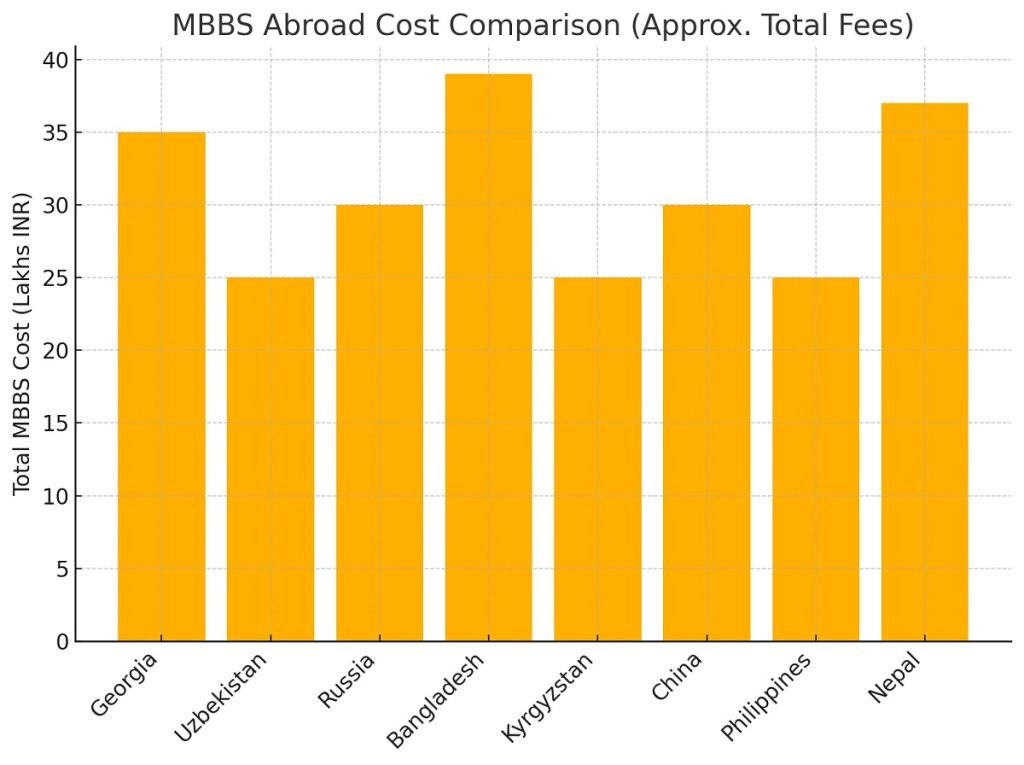
Here is a Brief Overview of Popular Destinations with key Statistics and Trends:
1. Russia
One of the most popular countries for Indian MBBS students, with over 10,000 students enrolling each year. Universities here are often accredited and often offer one of the most affordable programs available.
2. Georgia
By 2025, over 3,000 Indian students enroll in medical universities each year. These institutes are NMC-approved, affordable, English-medium and offer easy visa processing.
3. Nepal
Growing in popularity due to proximity and cultural familiarity; fees range between ₹50 to 55 lakh. Around 500 Indian MBBS students enroll each year. Recognized by the World Health Organization and Indian authorities, although FMGE (now NEXT) is a requirement to practice in India.
Europe: UK, Germany, Canada, USA
While MBBS-specific numbers are not available, broad trends show large Indian student populations:
| Germany | Around 60,000 Indian students in 2024-25, representing a 20% year-on-year increase, primarily studying STEM and medical-related subjects. |
| Canada | Will host 137,608 Indian students in 2025; though it is not just MBBS, it is also gaining ground for postgraduate medical and allied programmes. |
| United Kingdom | Around 92,355 Indian study visa holders in 2025, supported by post-study work visa policies. |
| USA | Largest numbers, 331,602 Indian students by 2025, but visa, cost and political issues are reducing its appeal. |
In Short:
Indian students are increasingly opting to study MBBS abroad due to domestic supply-demand imbalances, high costs in private medical colleges, and attractive options abroad. Russia, Georgia, China, and their regional neighbours are gaining popularity as they offer affordable, accredited, and accessible paths to becoming a doctor. Over the past three years, these trends have strengthened: medical education abroad is becoming a strategic choice, not a second-rate one, for candidates seeking a global medical career.
Also Read: MBBS in Georgia for Indian Students: Colleges, Fees, Approvals and Admission