Established in 1954, the “Bharat Ratna” Award is India’s highest civilian honour. The name means “Jewel of India,” and it is given to those who have made outstanding contributions to the nation.
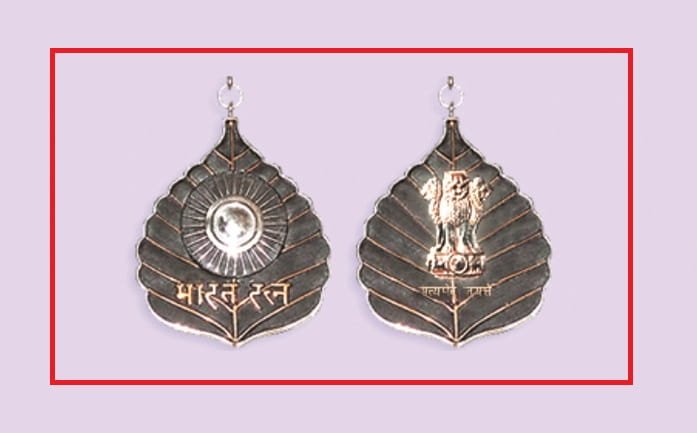
The award is not limited to any specific field. It recognises outstanding service in areas such as public affairs, science, art, literature, and social service. Over time, its scope has expanded to include achievements in sports and other fields of human endeavour. The medal is unique. It resembles a peepal leaf and bears the image of the sun on the obverse, with “Bharat Ratna” written in Devanagari script. The reverse bears India’s state emblem and the national motto, “Satyameva Jayate.”

Bharat Ratna Award: Some of the Most Famous People Include:
| C. Rajagopalachari | One of India’s first recipients. The last Governor-General. |
| Dr. Sarvepalli Radhakrishnan | Philosopher and the second President of India. |
| Dr. A.P.J. Abdul Kalam | Scientist and former President, known as “Missile Man of India.” |
| Mother Teresa | Mother Teresa, also known as Saint Teresa of Calcutta, was an Albanian-Indian Roman Catholic nun who founded the Missionaries of Charity, a religious organisation dedicated to serving the “poorest of the poor”. |
| Nelson Mandela | Nelson Mandela was a South African anti-apartheid revolutionary, political leader, and philanthropist who served as South Africa’s first Black president from 1994 to 1999. |
| Sachin Tendulkar | First sportsperson to receive this award. |
| Atal Bihari Vajpayee | Former Prime Minister, known for his leadership and public service. |
There is no formal provision that Bharat Ratna recipients must be Indian citizens. It has been awarded to a naturalized Indian citizen, Mother Teresa, in 1980, and to two non-Indians, Abdul Ghaffar Khan of Pakistan in 1987 and former South African President Nelson Mandela in 1990.
Sachin Tendulkar, at the age of 40, became the youngest person and the first sportsperson to receive the honour. Dhondo Keshav Karve was the oldest living recipient when he was awarded it on his 100th birthday on 18 April 1958. As of 2024, the award has been given to 50 people, 15 of whom were posthumous.
The Prime Minister recommends names to the President of India, who presents the award. There is no fixed number of awardees each year, but usually no more than three are awarded in a year. The “Bharat Ratna” is not just a medal. It is a symbol of the nation’s appreciation for those who have shaped India’s intellectual, cultural, scientific, and political landscape.
Also Read | MBA Jobs in India: What’s Changing in MBA Education and What to Expect in 2026