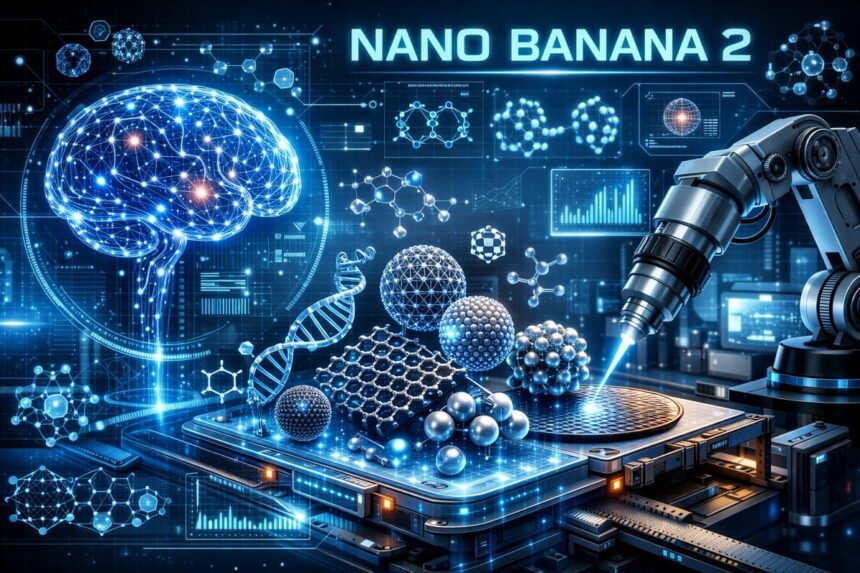
Nano Banana 2, the latest state-of-the-art image model, is a second-generation platform designed to accelerate, improve accuracy, and scale nanoscale material design. It combines nanotechnology, data modelling, and automation into a single system that helps researchers and manufacturers design, test, and produce nano-structured materials with significantly less trial and error. This article explains how Nano Banana 2 works, its differences from earlier systems, and its current uses.
What is Nano Banana 2?
Google DeepMind has quietly rolled out Nano Banana 2 (officially Gemini 3.1 Flash Image), which is Google’s AI image generation model, launched on February 26, 2026.
The Nano Banana 2 brings the high-speed intelligence of Gemini Flash (Gemini is a family of multimodal large language models developed by Google DeepMind); it combines the improved output, faster results, unique intelligence, and visual fidelity of its predecessor. It serves as an advanced nano-engineering platform designed to be accessible to a wider audience to:
| Analyze materials at the atomic and molecular level |
| Simulate structural behavior before physical production |
| Optimize nano-formulations using machine learning |
| Support automated nano-manufacturing processes |
| It serves as a bridge between lab research and industrial-scale production. |
The first version focused primarily on modeling and simulation. Nano Banana 2 (officially Gemini 3.1 Flash Image) enhances this with robust AI integration, real-time feedback systems, and improved compatibility with manufacturing equipment.

Key Features of Nano Banana 2
Nano Banana 2 combines the speed of the Flash Model family with features already available in the Pro tier, such as 4K resolution, accurate text rendering, and improved subject consistency. To understand how it works, it’s helpful to look at the main modules that power it.
Nano Modelling Engine: At its core is a high-precision modelling engine that maps atomic and molecular structures. It uses computational chemistry algorithms to simulate:
+ Bond interactions
+ Molecular stability
+ Thermal response
+ Electrical conductivity
+ Mechanical stress tolerance.
Instead of performing dozens of physical experiments, researchers can digitally simulate thousands of variations in a fraction of the time.
AI Optimisation Layer
Nano Banana 2 integrates machine learning models trained on large materials science datasets. These models:
+ Predict how small structural changes affect performance
+ Identify optimal nanoparticle shapes and sizes
+ Suggest new compound combinations
Detect unstable configurations before production For example, if a developer is designing a nano-coating for corrosion resistance, the system can virtually test multiple compositions and rank them based on durability and cost efficiency. This reduces the research cycle from months to weeks.
Also Read: Google’s Gemini AI Lyria 3 Music Tool Turns Text and Photos into Original Songs