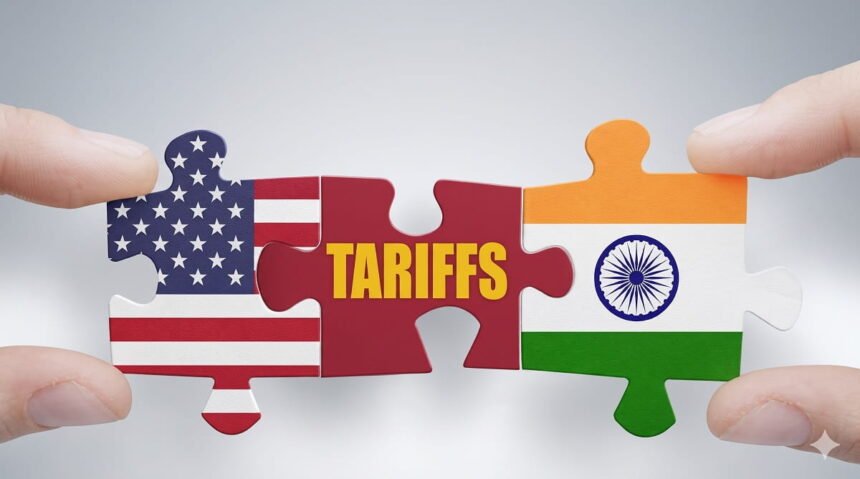
The Trump administration is preparing to unveil proposed new tariffs on India, China, the European Union (The European Union is a political and economic union of 27 member states located primarily in Europe), and 13 other major trading partners following an eight-month Section 301 investigation into alleged excess industrial capacity and industrial subsidies.
According to ‘The Wall Street Journal’, the United States is preparing to increase tariffs this week. A Bloomberg report suggests that this move could be taken as early as Tuesday. Indian officials are closely monitoring the outcomes of this investigation. Before the final tariffs are announced, there are likely to be hearings on the matter within the next 45 days.
Following the investigation, the Trump administration is preparing to impose new tariffs on India, China, and 14 other countries. After facing a setback from the U.S. Supreme Court regarding the use of emergency powers to impose ‘reciprocal tariffs’, the Trump administration initiated two investigations under ‘Section 301’.
‘Section 301’ Investigation: The government does not anticipate any negative impact.
An additional tariff of 10-12.5 percent was previously imposed on imports from over 50 countries, including India. These nations were accused of failing to prevent the import of goods produced using forced labor, which in turn harmed U.S. exports. Now, the results of the second investigation are awaited.
Given the current situation, the government does not expect any adverse effects. The government maintains that there is no ‘structural excess capacity’ in India; rather, the surplus production is intended to meet future demand in what is the world’s fastest-growing major economy.
During discussions with the U.S. government, Indian officials clarified that the government has not provided any subsidies or other forms of support to expand capacity. Furthermore, it was pointed out that any country with a surplus of domestic production naturally exports that excess volume.
Following the report from the Office of the United States Trade Representative (USTR), there will be hearings before the final tariffs are announced. During the first investigation, India had succeeded in securing certain concessions. Initially, a 12.5 percent tariff was proposed, which was subsequently reduced to 10 percent.
The findings of this investigation will provide clarity regarding Trump’s new tariff framework, though details on the final tariffs are expected in about 45 days. Once the final tariffs are determined, governments will engage in negotiations for “trade deals.” India remains confident that it will be able to secure an agreement that provides its exports with a “comparative advantage” over other competitors in the region.
The first set of tariffs, linked to forced labor, has already been challenged in U.S. courts, and similar legal action is likely against the second set, especially given that the USTR’s findings are largely uniform across almost all the countries involved. Regarding “structural excess capacity,” action is being taken against all of the United States’ top 20 trading partners, with the exception of Canada, the UK, Brazil, and Australia; this includes major European nations that are part of the European Union (EU).
The list also encompasses countries such as Norway, Indonesia, Cambodia, and Bangladesh, nations that do not rank among the U.S.’s top 20 trading partners in terms of the exchange of goods and services.