The IITs are set to add approximately 6,000 new seats across undergraduate, postgraduate, and doctoral programs in Robotics Engineering, Physical AI, and Space Engineering and Technology. Under a new initiative, the ‘Bhupat and Jyoti Mehta Family Foundation’ (MFF), which has previously supported the establishment of several centers across six IITs, will collaborate with multiple IITs to develop these specialised programs, starting in 2027.
In a statement, the Foundation clarified that of the 6,000 proposed seats, 5,000 will be dedicated to Robotics Engineering and Physical AI, comprising 2,500 BTech, 1,200 Master’s, and 1,300 PhD seats. The remaining 1,000 seats will be for Space Engineering and Technology, consisting of 500 BTech, 300 Master’s, and 200 PhD seats. This initiative will also be supported by over 120 dedicated faculty members.
Robotics Engineering and Physical AI programs
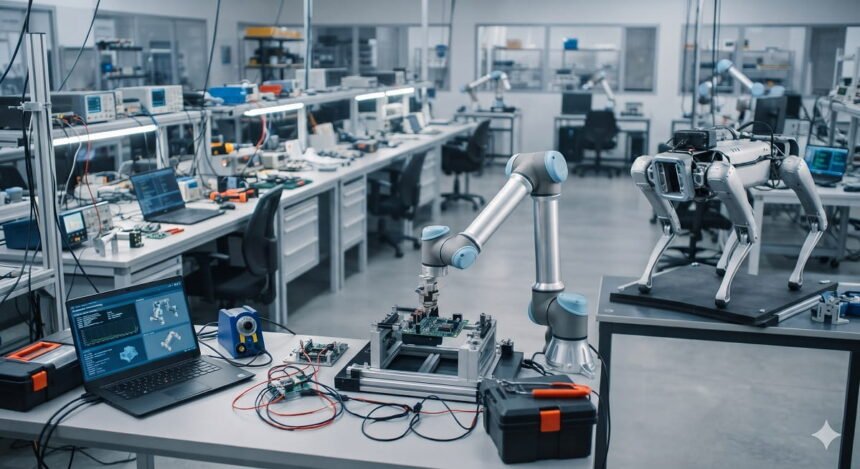
The Robotics Engineering and Physical AI programs will primarily focus on applications in sectors such as healthcare, defense, agriculture, and industrial manufacturing. The curriculum will integrate mechanical and electrical engineering with software, machine learning, computer vision, sensing, and control systems.
Students will work on both hardware (physical parts like circuits, sensors, and processors) and software. The programs will encompass advanced research areas such as foundation models, digital twins, humanoid and legged robots, swarm robotics, and soft robotics. These programs are expected to include industry-linked ‘capstone projects‘ and a ‘paid industry-residency semester’ at an IIT. The curriculum will take into account India-specific conditions, such as heat, dust, power availability, and cost constraints.
Potential applications include agricultural automation, rural healthcare, and robotics for small-scale manufacturers. Students will also examine the societal implications of automation, including its impact on employment and inequality.
School of Space Science and Technology
A proposed ‘School of Space Science and Technology‘ at an IIT will focus primarily on satellite navigation, space robotics, and human spaceflight. The announcement did not specify which IIT will host this school, nor did it name the individual institutions where these programs will be launched.
The foundation stated that the initiative aims to expand specialized higher education opportunities in emerging technology sectors and develop a new generation of skilled professionals for India’s manufacturing, robotics, and space sectors.

Rahul Mehta, head of the foundation, noted that approximately 5,000 students will be enrolled in undergraduate, postgraduate, and doctoral programs focused on robotics and physical AI. In total, the initiative will encompass 6,000 students, including those in the field of space technology. Since 2019, the foundation has collaborated with six IITs to establish eight schools and centers focused on areas such as data science and artificial intelligence, healthcare and biomedical engineering, and sustainability.
These programs have seen a total of over 4,000 enrollments across BTech, MTech, and PhD courses. Now, through this new initiative, the partnership will be expanded to include the fields of robotics, physical AI, and space technology.