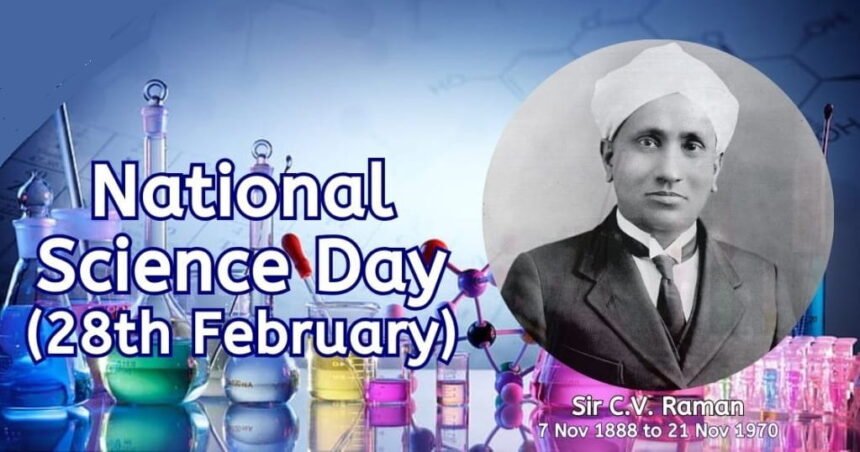
Every year on February 28th, India celebrates National Science Day. This date marks a major moment in Indian scientific history. On this day in 1928, physicist Sir C.V. Raman announced his discovery of the Raman Effect, a breakthrough for which he later received the Nobel Prize.
National Science Day isn’t just about commemorating a single discovery. It’s about recognizing the role of science in everyday life and understanding what scientists actually do.
Why February 28th is Important
C.V. Raman demonstrated that when light passes through a transparent material, a small fraction of it changes its wavelength. This phenomenon, now known as the Raman Effect, helped scientists better understand how light interacts with matter. His work laid the foundation for modern spectroscopy, which is used in chemistry, medicine, and materials science. India chose February 28 (National Science Day) to honour this achievement and inspire future generations to explore science.
What do Scientists Actually do?
When people hear the word “scientist,” they often imagine someone in a lab coat mixing chemicals or peering into a microscope. This image isn’t wrong, but it’s incomplete. What scientists do can best be explained as the creation of knowledge. We are all consumers of knowledge.
A farmer needs to know when to sow and harvest, a vegetable vendor needs to know how to do basic calculations, and an engineer needs to know how to design a bridge that can withstand the required load. Typically, we acquire this knowledge from books, teachers, the internet, and so on. Scientists do much more.
1. They ask questions: Curiosity is at the heart of science. Scientists start with simple but powerful questions:
+ Why does the sky change colour when the sun sets?
+ How can we cure a disease?
+ What forces a rocket to escape Earth’s gravity?
These questions lead to research. Sometimes the questions are small and specific. Sometimes they are big and global. But every discovery begins with curiosity.
2. They Conduct Experiments
Scientists conduct experiments following the scientific method, which involves observing a phenomenon, formulating a hypothesis, designing a controlled procedure, collecting data, and analysing the results to conclude. Experiments are typically conducted in a laboratory to ensure safety and accuracy. Key steps include using a control group, repeating tests for accuracy, and maintaining ethical standards. Scientists test ideas. They design experiments to see if their hypotheses are correct. For example:
+ A medical researcher might test a new vaccine.
+ An environmental scientist might measure pollution levels in a river.
+ A physicist might analyse particles inside an accelerator.
Experiments are not random. They employ careful methods so that results can be replicated and verified.
3. They collect and analyse data
Science relies on evidence. Scientists collect data through observation, measurement, and testing. Then they analyse it.
+ A climate scientist might study decades of temperature records.
+ A space scientist might examine images sent from satellites.
+ A biologist might compare DNA samples.
The goal is to find patterns and draw reliable conclusions.
Why National Science Day is Important Today
India is a country with a young population. Promoting scientific thinking is essential for innovation and progress. National Science Day promotes:
| Scientific thinking |
| Critical thinking |
| Interest in STEM careers |
Respect for evidence-based reasoning It reminds us that science isn’t just confined to the lab. It’s a way of thinking. It encourages asking questions, checking facts, and being open to new evidence.
National Science Day: The Big Message
You don’t have to be a professional scientist to think scientifically. When you question information, seek evidence, and avoid jumping to conclusions, you’re practising science in your everyday life. National Science Day isn’t just about celebrating famous scientists like C.V. Raman. It’s about recognising the value of curiosity and evidence in building a better future.
Science moves silently. It improves health, connects people, feeds people, and explores space. Behind every advancement is someone who asked questions and never stopped searching for answers.
Also Read | Google’s Gemini AI Lyria 3 Music Tool Turns Text and Photos into Original Songs