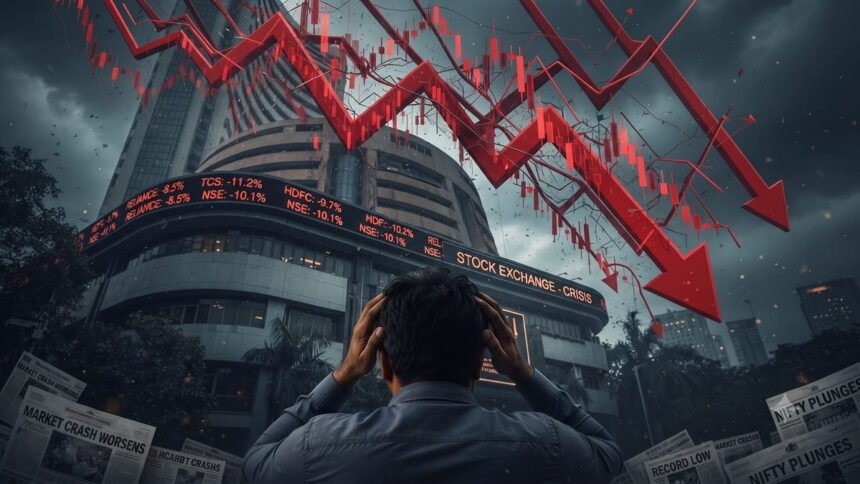
Stock Market is Falling: India’s GDP has recorded a growth rate of 7.8%, surpassing estimates. The World Bank expects the year to perform even better than previously projected. Despite this, Dalal Street is witnessing a sharp decline. So, what is happening? Why is the stock market falling when the economy is performing so well?
This paradox, a rapidly growing GDP alongside a falling stock market, is one of the most common puzzles in the financial world. While India’s macroeconomic indicators appear robust (with GDP growth hovering around 7%), the stock market often behaves less like a scorecard of current GDP and more like a forward-looking machine with a volatile mood.
A combination of valuation reality checks, structural shifts, and external pressures explains what is happening in Indian markets:
1. Valuation Reality Check (Overheating): For a prolonged period, Indian equities traded at significantly higher ‘Price-to-Earnings’ (P/E) multiples compared to their global peers. Investors had already priced in expectations of sustained future growth. When market valuations are at near-perfect levels, even good (though not spectacular) corporate earnings can trigger a sharp market correction. The market isn’t necessarily collapsing; it is undergoing a difficult ‘valuation reset’ to align share prices with the reality of actual corporate earnings.
2. Sustained FII (Foreign Institutional Investor) Selling: Foreign investors are pulling their capital out of Indian markets. There are several reasons for this:
A) Changes in global yields: When global risk sentiment shifts, or other markets (such as a recovering China or cheaper emerging markets) appear attractive, foreign funds withdraw capital from India and invest elsewhere. This can be described as a “Sell India, Buy Elsewhere” strategy.
B) Trading dynamics: Even though India’s structural growth story is impressive, foreign portfolio managers focus on relative valuations. If they perceive Indian stocks as overpriced, they book profits and exit; this exerts significant downward pressure on large-cap indices like the Nifty and Sensex, causing them to fall.
3. Corporate earnings vs. macro GDP growth: It is important to remember that GDP and corporate profits are not the same thing. GDP measures total economic output (including infrastructure, the unorganised sector, agriculture, and government spending on services). The stock market, however, is concentrated in specific sectors (such as banking, IT, and large conglomerates) and represents formal, organised corporate entities.
During periods of high inflation or fluctuating input costs, corporate profit margins can contract even while the broader macro GDP is expanding. If earnings growth remains in the single digits (below 10%) against expectations of double-digit growth (10% or higher), stock prices tend to fall.
4. Macro challenges and global pressures
A) Crude oil and geopolitics: India imports the majority of its crude oil requirements. A surge in global oil prices, driven by tensions or geopolitical conflicts in the Middle East, immediately sparks fears of inflation, impacts corporate margins (particularly in the consumer goods, paint, and aviation sectors), and weakens the rupee.
B) Monetary Policy and Liquidity: Central bank measures to curb inflation mean that liquidity is no longer as cheap or abundant as it once was. Prolonged high interest rates make borrowing expensive for companies, while investors begin to favour safer fixed-income assets over riskier equities.
5. Slowing Retail Momentum: For a long time, domestic retail investment (via SIPs and mutual funds) supported the market against outflows of foreign capital. However, extended periods of consolidation and market correction tend to dampen retail momentum. Without fresh positive triggers or significant liquidity injections, markets often begin to slide under their own weight.
Think of GDP as the health of a marathon runner and the stock market as the runner’s heart rate at any given moment
Summary: Think of GDP as the health of a marathon runner and the stock market as the runner’s heart rate at any given moment. The runner is healthy and sprinting (7% GDP growth), but may be running up a steep incline in heavy shoes (high valuations) while facing headwinds (global capital outflows and rising oil prices).