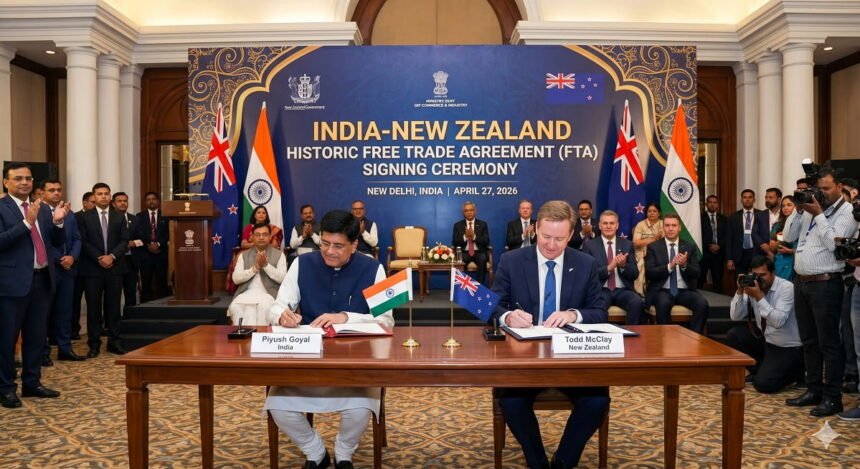
In a landmark move for bilateral relations, India and New Zealand officially signed a “historic” Free Trade Agreement (FTA) on April 27, 2026. The pact, signed in New Delhi by India’s Commerce and Industry Minister Piyush Goyal and New Zealand’s Trade and Investment Minister Todd McClay, marks a defining shift in the economic landscape of the Indo-Pacific.
This agreement is being hailed not just for its depth but for its speed; negotiations were revived in March 2025 and concluded in record time by December of the same year.

Key Highlights of the Free Trade Agreement
The free trade agreement deal is a comprehensive framework that goes beyond simple tariff reductions, focusing on investment, services, and labour mobility.
| Feature | Details |
| Indian Exports | 100% duty-free access to the New Zealand market. |
| New Zealand Exports | Tariffs eliminated or reduced on 95% of current exports to India. |
| Investment | A binding commitment from New Zealand to invest $20 billion in India over 15 years. |
| Labor Mobility | 5,000 new Temporary Employment Entry visas for Indian professionals. |
| Youth Exchange | 1,000 Working Holiday Visas annually for young Indians. |
Strategic Gains for India
For India, the free trade agreement provides a level playing field in a high-income market and serves as a strategic gateway to the wider Oceania and Pacific Island regions.
A) Manufacturing Boost: Labour-intensive sectors such as textiles, apparel, leather, footwear, gems & jewellery, and engineering goods will now enter New Zealand duty-free (down from previous tariffs of up to 10%).
B) Service Sector Expansion: The deal creates dedicated pathways for Indian professionals in IT, Healthcare, Engineering, and Education. Notably, it recognises “iconic occupations,” including AYUSH practitioners, Yoga instructors, and Indian chefs.
C) Student Benefits: For the first time, New Zealand has signed an annex on student mobility with any country. Indian students gain extended post-study work visas (up to 3 years for Master’s and 4 years for Doctorates) and guaranteed work rights of 20 hours per week.
D) Industrial Inputs: India secured duty-free access to critical raw materials such as wood logs, coking coal, and metal scrap, thereby lowering production costs for domestic manufacturers.
Balancing Domestic Interests
While the free trade agreement deal is ambitious, India has maintained a “defensive” stance on sensitive sectors to protect its domestic base, particularly the farming community.
A) Dairy Exclusion: In a major win for Indian dairy farmers, all dairy products (milk, cheese, whey, etc.) remain on the exclusion list and are not part of the tariff liberalisation.
B) Sensitive Agriculture: Other products kept out of the deal include onions, pulses (chana, peas), corn, sugar, and certain vegetable oils.
C) Safeguard Mechanisms: The free trade agreement includes “Trade Remedies” that allow India to pause tariff cuts or raise duties if there is a sudden, harmful surge in imports.
Why Now? The Global Context
The signing comes at a time when both nations are looking to diversify their economic partnerships. For New Zealand, the deal represents a “once-in-a-generation” opportunity to reduce its heavy trade reliance on China. For India, it is a significant step toward the Viksit Bharat 2047 vision, marking its 9th FTA with advanced economies.
“This is far more than an agreement on tariffs; it is a partnership of trust. We have chosen each other at a time when the world economy is being recast.” Piyush Goyal, Union Minister of Commerce and Industry. As the agreement moves toward ratification in both parliaments, businesses on both sides are already preparing to tap into a corridor that promises to double bilateral trade to $5 billion within the next five years.
Also Read: Donald Trump Evacuated After Shots Fired at White House Correspondents’ Dinner