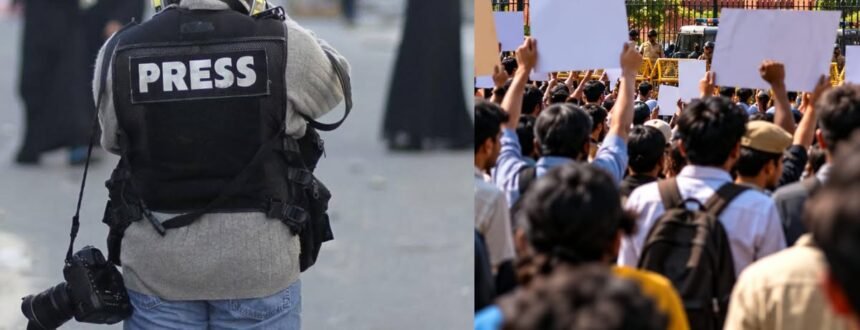
New Delhi: The Supreme Court observed on Thursday that if every citizen were to become a journalist, it would lead to problems. This remark came during the hearing of several Public Interest Litigations (PILs) seeking protection for the freedom of expression of freelancers, independent journalists, and content creators (such as those who make ‘reels’). These individuals often arrive in large numbers at protest sites, locations already crowded with accredited journalists from registered media organizations.
Senior Advocate Indira Jaising, appearing before a bench comprising CJI Surya Kant and Justice Joymalya Bagchi, argued that the Delhi Police does not recognise independent or freelance journalists covering protests, instead demanding that they possess accreditation from the Press Information Bureau (PIB). She suggested that a national protocol should be established for the police to ensure they do not obstruct the professional work of any journalist who holds an identification (ID) card from their respective organisation.
” Justice Bagchi added, “It needs to be examined in depth whether the right to freedom of expression grants every citizen the entitlement to be a journalist.
However, CJI Surya Kant urged caution, stating, “We must keep one thing in mind: if everyone starts becoming a journalist, it will create difficulties for everyone else.” Justice Bagchi added, “It needs to be examined in depth whether the right to freedom of expression grants every citizen the entitlement to be a journalist. This is complex. There are varying levels of protection for accredited journalists, those working for registered media houses, freelance journalists, influencers, or content creators.”
CJI Surya Kant remarked, “The issue of whether there should be a specific category of journalists entitled to additional protection requires detailed consideration.” Justice Bagchi further noted, “The ‘Working Journalists Act’ establishes different classes among journalists. We will have to examine all these aspects.” Solicitor General Tushar Mehta stated that in today’s digital age, anyone with a mobile phone can claim to be an independent or freelance journalist.
In reality, however, they are often merely creating ‘reels’ to gain popularity on social media and earn money, sometimes by presenting one-sided narratives and at other times by sensationalising events. While affirming that female journalists should not be harassed, Tushar Mehta also emphasised that the same principle should apply to female police personnel.