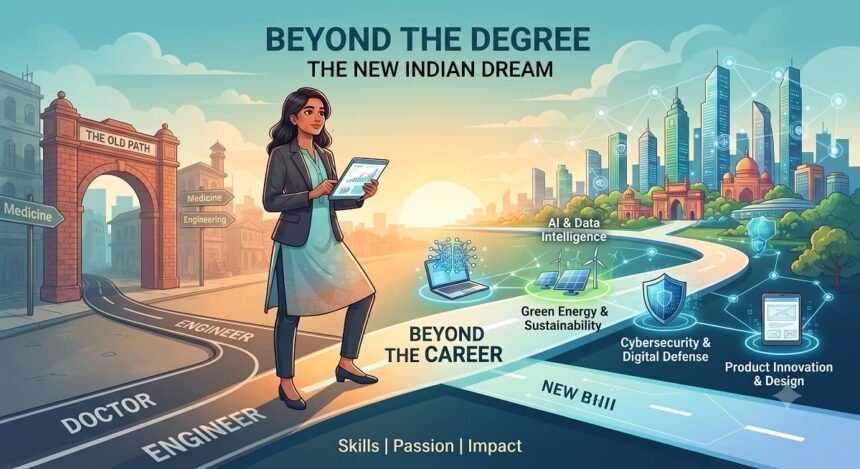
Beyond the Degree: From coaching centres to family gatherings, pursuing engineering and medicine had become the benchmark for success, careers associated with good, stable earnings, social prestige, and upward mobility. Parents encouraged their children to pursue these paths, schools promoted them, and students gravitated toward them, believing there were hardly any other respectable alternatives. However, this mindset is gradually shifting.
This change is unfolding alongside one of the most significant transformations in the global job market. The World Economic Forum’s ‘Future of Jobs Report 2025’ projects that by 2030, structural changes in the labour market will create 170 million new jobs, while 92 million existing jobs could disappear. The report also estimates that the current skill sets of 39 percent of the workforce will either evolve or become obsolete.
Consequently, while engineering and medicine remain highly sought-after career choices in India, they are no longer the only primary options for the generation entering a labour market reshaped by artificial intelligence, digital business, renewable energy, startups, and a skills-first economy.
By 2026, the traditional mindset regarding careers in India, that one must become a doctor or an engineer to be successful, is shifting. While these professions remain prestigious, the definition of a “stable” and “successful” career has broadened significantly. The most significant change in 2026 is that hiring is no longer based solely on degrees or qualifications but on skills, specifically, on demonstrating the actual ability to perform the job.

Major Shifts in India’s Career Landscape:
Prioritising Skills Over Degrees: employers in India today place greater value on proven work capabilities, projects, certifications, and portfolios than on traditional degrees. A 2026 survey reveals that approximately 80% of employers prioritise practical skills.
The Rise of “Hybrid” Careers:
Today’s most successful professionals combine traditional fields with digital skills. You don’t just work in healthcare; you could also work in health-tech, using AI for diagnostics.
A) Location Freedom: With 70% of India’s tech companies adopting hybrid or remote models, professionals from smaller towns are no longer compelled to move to cities like Mumbai, Bengaluru, Hyderabad, Delhi-NCR, or Pune to pursue fast-growing careers.
B) The Importance of “Purpose”: The younger generation (Gen Z) increasingly prioritizes work-life balance and social impact, gravitating towards sustainability and ethical technology.
New “Dream” Careers:
Beyond medicine and engineering. Here are some key career paths defining success in 2026:
1. Data and AI Intelligence Track: There is now a growing demand for specialised intelligence rather than just general software engineering.
| Roles | AI/ML Engineer, Data Scientist, NLP (Natural Language Processing) Specialist. |
| Why this is the new “engineering” | These roles have become the backbone of every sector, from banking to retail and agriculture. |
2. Digital Protection Track (Cybersecurity): As India’s digital economy has expanded, so have the risks. Securing the country’s digital infrastructure has become a critical necessity.
| Roles | Ethical Hacker, Cybersecurity Analyst, Cloud Security Architect. |
| Why it is growing | It offers strong job security because the need for digital protection will persist as long as digital commerce exists. |
3. Green and Sustainability Track: Driven by massive investments in renewable energy in India, “green careers” have evolved from niche environmental studies into mainstream industrial roles.
| Roles | Renewable Energy Consultant, ESG (Environmental, Social, and Governance) Analyst, EV (Electric Vehicle) Operations Lead. |
| Why it is growing | India aims to achieve significant renewable energy capacity, creating a surge in jobs for professionals who understand both technology and environmental systems. |
4. Product and Creative Design Track: The internet economy requires not just coders, but also individuals who can bridge the gap between human needs and technology.
| Roles | UI/UX Designer, Product Manager, Content Strategist. |
| Why it is growing | Companies have realized that a great product isn’t just about code; it is about how seamless and engaging the user experience is. |
How to Advance Your Career in 2026
If you are thinking about your future today, do not limit yourself to just becoming a “doctor or engineer.”
Build your portfolio: Whether it is code on GitHub, a design series on a blog, or a research paper on sustainability, taking action is now more important than just studying.
A) Focus on “stacking”: The most valuable professionals in 2026 will be “skill stackers”, individuals who possess a combination of skills, such as finance and data analytics, or healthcare and digital marketing.
B) Be prepared for change: The role you hold in your first job might not exist in its current form five years down the line. Focus on essential skills like critical thinking, communication, and project management, skills that never become obsolete. However, this equation is quietly shifting:
This transformation is occurring alongside one of the most significant shifts in the global job market. The World Economic Forum’s ‘Future of Jobs Report 2025’ projects that by 2030, structural changes in the labour market will create 170 million new jobs, while 92 million existing jobs could disappear.
The report also estimates that the current skill sets of 39 per cent of workers will change or become obsolete.
Thus, even though engineering and medicine remain India’s most preferred professions, they are no longer the only mainstream goals for the generation entering a labour market transformed by artificial intelligence, digital business, startups, renewable energy, and a skills-first economy.
Also Read: MBBS in Georgia for Indian Students in 2026: Top Universities, Fees, Eligibility and Admission