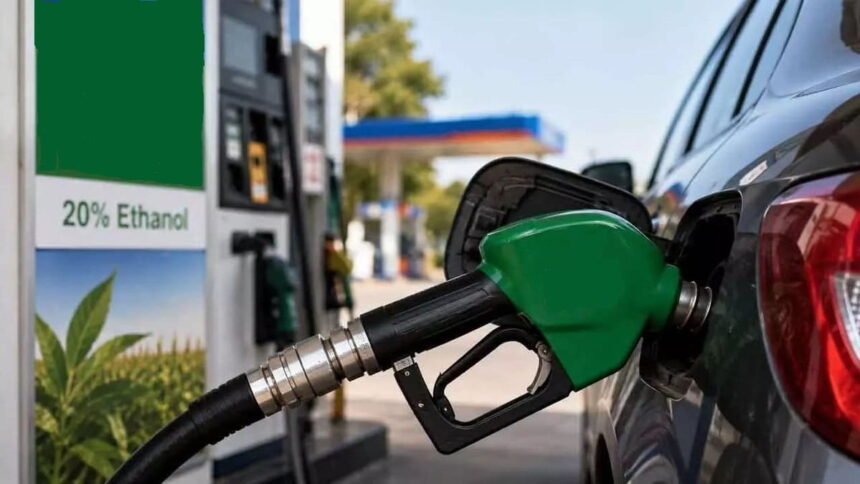
e20 Fuel: India has witnessed one of the world’s most rapid transitions in the fuel sector. The ethanol blending rate in petrol rose from approximately 1.5 percent in 2014 to 20 percent last year, enabling the country to achieve its target five years ahead of schedule.
e20 fuel, a blend of 20% ethanol and 80% petrol, has been introduced in India as a cleaner and more sustainable energy option. Since ethanol has a lower energy density (calorific value) than pure petrol, the engine requires more fuel to cover the same distance, which can lead to a slight reduction in fuel economy (mileage).
While cars manufactured in India from April 2023 onwards are e20-compliant (designed for 20% ethanol-blended petrol), leading car manufacturers claim that older models also run without problems. However, vehicles built before 2023 may experience a drop-in mileage. Following public dissatisfaction regarding reduced mileage and increased wear and tear on engine components associated with e20, the government acknowledged that e20 could lead to a 3 to 5 percent reduction in fuel economy; however, it also maintained that there is no evidence of e20 causing damage to engines or their components.
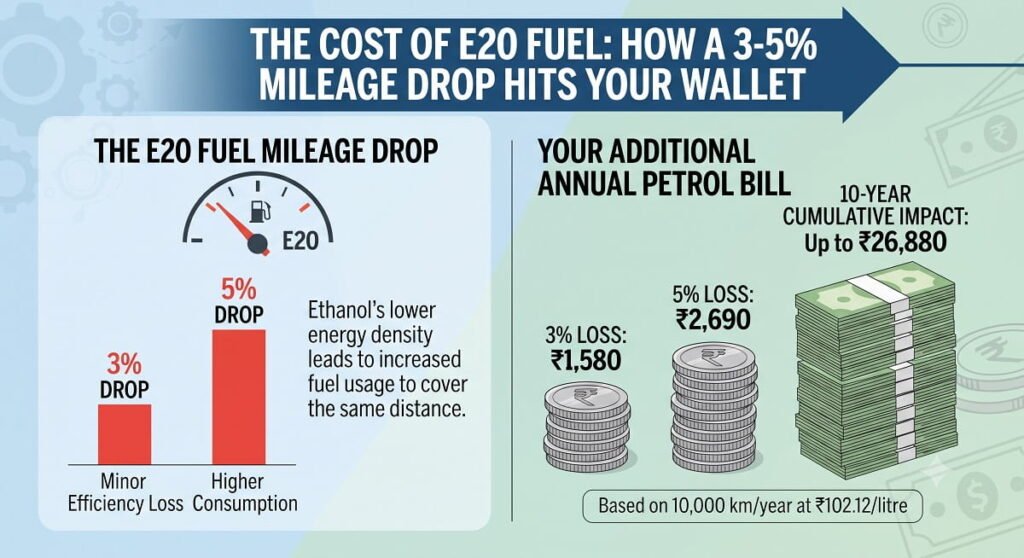
Financial Impact of 3-5% Lower Mileage
The Indian government has admitted that using e20 fuel can reduce the fuel efficiency of some vehicles by 3-5%. While this decrease might seem small, it increases your fuel expenses long term. Based on a car with a base mileage of 20 kmpl driving 10,000 km a year (at a fuel price of ₹102.12 per litter), the extra costs are as follows:
| Duration | At 3% Mileage Loss | At 5% Mileage Loss |
| 1 Year | ₹1,580 | ₹2,690 |
| 5 Years | ₹7,900 | ₹13,440 |
| 10 Years | ₹15,800 | ₹26,880 |
The lower price of e20 fuel does not compensate for the drop-in mileage
The lower price of e20 fuel does not compensate for the drop-in mileage, whereas customers argue that it should be cheaper than pure petrol. The government maintains that e20 is not cheaper because farmers must be paid a fair price for it; for instance, ethanol derived from maize is procured at a rate of approximately ₹71.86 per liter. The ministry has also stated that the objective of e20 is not to lower fuel bills but to ensure price stability.
It cited a comparative table showing that between June 2022 and June 2026, petrol prices in Delhi rose by only 5.6 percent. In contrast, during the same period, prices surged significantly in Pakistan (39.8 percent), Bangladesh (42.7 percent), Sri Lanka (36.7 percent), and Nepal (20.4 percent), while rising by approximately 18-19 percent in France, Germany, and Italy.
Also Read: Tech Capital: Why is Bangalore now known as Bengaluru, India’s Silicon Valley?