
Career Options After 10th: The moment the Class 10th results are announced, the celebration usually transitions into a high-stakes debate: “Which Course should I choose?”
Choosing the right course after class 10th is one of the first major educational decisions students make, because this decision isn’t just about the next two years; it’s about setting the direction for your career. The importance of choosing the right course in class 11th is linked to the fact that the subjects chosen now can affect future career goals, higher education paths, and the development of specific skills. There is no “best” subject; there is a “right” stream for your specific interests and strengths.
Career Options After 10th: Decision Feels Extremely Difficult
For many students, this decision feels extremely difficult because it’s made at an age when they are still discovering their interests and strengths. The influence of friends and family aspirations can make this process even more challenging. So, students need to make this choice very carefully, considering important factors such as self-awareness, academic skills, career options, and future opportunities.
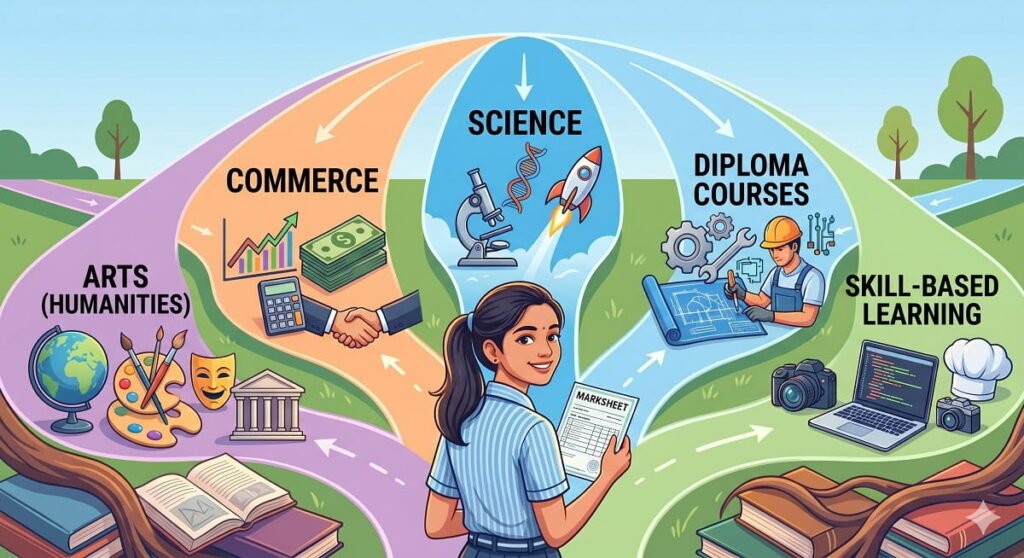
Moving from Class 10 to Class 11 is a crucial stage in a student’s education. It’s the first time they choose a path that shapes their future: picking a ‘course’ (subject group). Be it Science, Commerce, Arts or Diploma, this choice needs careful thought, free from outside pressure or popular trends.
1. The Science Stream: The Path of Innovation
If you are fascinated by how the world works, from the microscopic level to the universe, then Science is the traditional option people choose. It is generally divided into two groups:
| PCM (Physics, Chemistry, Mathematics) | Best for aspiring engineers, architects, and pilots. |
| PCB (Physics, Chemistry, Biology) | The essential route for medicine, dentistry, pharmacy, and biotechnology. |
Why choose it? It offers the most flexibility. A science student can switch to Commerce or Arts later, but the reverse is rarely possible. However, be prepared for a rigorous workload and competitive entrance exams like JEE or NEET.
2. The Commerce Stream: The Language of Business
Commerce is the backbone of the global economy. It focuses on how businesses operate, how money moves, and how markets are regulated. Core subjects include Accountancy, Business Studies, Economics, and Mathematics (optional but recommended).
Career Prospects:
| Chartered Accountancy (CA) | High-demand auditing and tax roles. |
| Management | Pursuing a BBA, then an MBA for leadership roles. |
| Finance & Banking | Investment banking, stock market analysis, and wealth management. |
Why choose it? If you have skills for numbers, logical reasoning, and an interest in the corporate world, Commerce offers high-paying, stable career paths.
3. The Arts (Humanities) Stream: The Study of Society
The days when the arts were considered a ‘backup’ option are now long gone. It is now one of the most diverse and intellectually stimulating streams. Its subjects include History, Geography, Political Science, Psychology, Sociology, and Literature.
Career Prospects:
| Civil Services (IAS/IPS) | The foundation for the UPSC exams. |
| Law | Transitioning into a 5-year integrated LLB. |
| Media & Design | Journalism, mass communication, and graphic design. |
| Social Sciences | Research, teaching, and international relations |
Why choose it? If you are creative, enjoy critical thinking, and want to understand human behaviour or governance, the Arts provides a broad horizon of opportunities.
4. Diploma Courses: The Fast Track to Employment
For those who want to jumpstart their career immediately or prefer practical learning over theoretical schooling, Polytechnic or Diploma courses are an excellent alternative to 11th and 12th grade.
| Engineering Diplomas | Mechanical, Civil, Electrical, and Computer Science. |
| Skill-based Diplomas | Fashion Design, Interior Design, Hotel Management, and Digital Marketing. |
Why choose it? These 3-year courses focus on technical skills. After completion, you can either start working or enter the second year of a B.Tech degree via “lateral entry.”
Career Options After 10th: How to Decide? (The Checklist)
Choosing a stream based on “what your best friend is doing” or “parental pressure” is a recipe for burnout. Instead, use this framework:
| Assess Your Aptitude | Do you genuinely enjoy the subjects? Don’t pick Science if you dread Mathematics, even if you want to be an engineer. |
| Research the End Goal | Look at the job roles at the end of the degree. Does the daily life of a Lawyer appeal to you more than that of a Doctor? |
| Consult a Counsellor | Sometimes an objective aptitude test can reveal strengths you didn’t know you had. Ignore the Stigma: Every stream, be it Arts or a Diploma, has the potential for a six-figure salary and a fulfilling life. Excellence is what matters, not the subject label. |
Career Options After 10th: Final Words
Your 10th-grade percentage is a stepping stone, not a prison. Don’t let a high score push you into a field you hate, and don’t let a low score stop you from following your passions in other ways.
Also Read: Top Private Engineering Universities in India 2026: Admission, Fees, and Last Dates