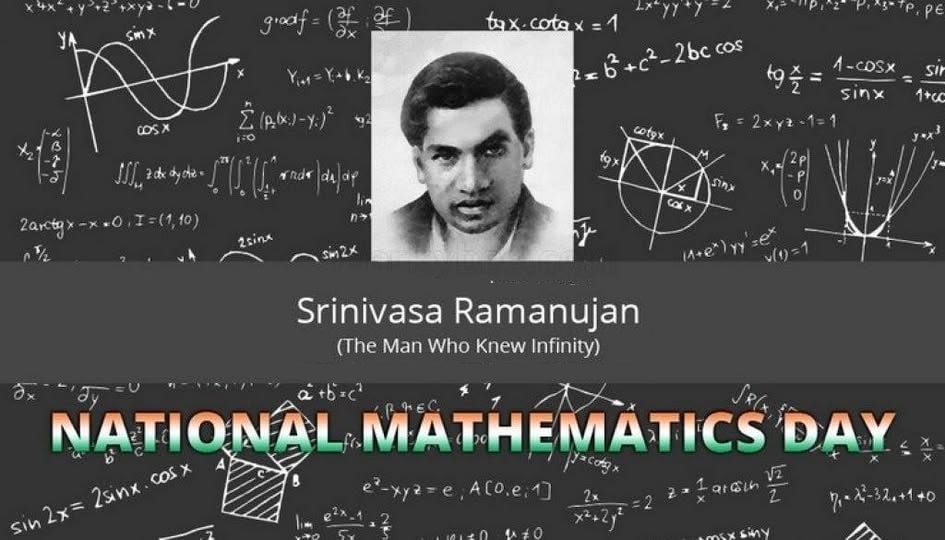
Every year on 22 December, India celebrates National Mathematics Day to honour the birth anniversary of one of the greatest mathematical minds the world has ever known, Srinivasa Ramanujan. In 2025, the day continues to serve a clear purpose: to recognise the power of mathematics in everyday life and to inspire young minds to think beyond formulas and exams.
National Mathematics Day is not just about numbers. It is about curiosity, persistence, and the ability to see patterns where others see chaos.
Why is National Mathematics Day celebrated?
This day was officially declared by the Government of India in 2012 to commemorate the 125th birth anniversary of Srinivasa Ramanujan. Since then, December 22nd has been dedicated to:
+ Fostering interest in mathematics among students
+ Highlighting the role of mathematics in science, technology, and innovation
+ Honouring India’s contribution to global mathematical thought
Schools, colleges, and research institutions across the country organise lectures, quizzes, exhibitions, and problem-solving sessions. The goal is simple: to make mathematics less intimidating and more engaging.
Who was Srinivasa Ramanujan?
Srinivasa Ramanujan was born on December 22, 1887, in Erode, Tamil Nadu. He grew up with limited resources and very little formal training, yet his understanding of mathematics was extraordinary.
By his teens, he was already working on difficult problems in number theory, infinite series, and continued fractions. Much of his work stemmed from his intuitive understanding. He often said that mathematical ideas came to him in dreams.
Despite facing poverty and frequent interruptions to his education, Ramanujan’s talent eventually caught the attention of British mathematician G. H. Hardy, who invited him to Cambridge University. That collaboration transformed the course of modern mathematics.
Ramanujan’s Contributions to Mathematics
Ramanujan’s work was far ahead of its time. Many of his results are still being researched today. Some of his most influential contributions include:
| Number theory, including the partition function |
| Rapidly converging infinite series |
| Modular forms, which are now crucial in modern physics and cryptography |
The famous Ramanujan numbers, such as 1729, are known as the smallest numbers that can be expressed as the sum of two cubes in two different ways
What makes his legacy unique is that many of his formulas were written down without formal proofs. Decades later, mathematicians are still proving and utilising them.
A Life of Struggle and Genius
Ramanujan’s life was short and challenging. He faced illness, cultural isolation in England, and financial hardship. He returned to India in poor health and died in 1920 at the young age of 32.
Yet, in his brief life, he accomplished work that transformed entire fields of mathematics. Today, his notebooks are studied worldwide, and his ideas continue to influence research in mathematics and theoretical physics.
Why Ramanujan’s Legacy Still Matters in 2025
In this age of data, algorithms, and artificial intelligence, Ramanujan’s story seems particularly relevant. He represents:
+ The importance of original thinking
+ The value of nurturing talent regardless of background
+ The idea that curiosity can outperform formal training
National Mathematics Day reminds us that mathematics is not just about crunching numbers. It’s about imagination, logic, and the courage to explore the unknown.
Conclusion
National Mathematics Day 2025 is a tribute to Srinivasa Ramanujan and the spirit of discovery he embodied. By celebrating this day, India honours not just a mathematician, but an idea – an idea that believes insights can come from anywhere and that knowledge has the power to transform the world. As students and educators reflect on this day, Ramanujan’s life offers an enduring lesson: genius doesn’t always follow a conventional path, but when recognised and nurtured, its impact can be everlasting.
Also Read: Prime Minister Modi launches the Global E-Library to promote traditional medicine worldwide