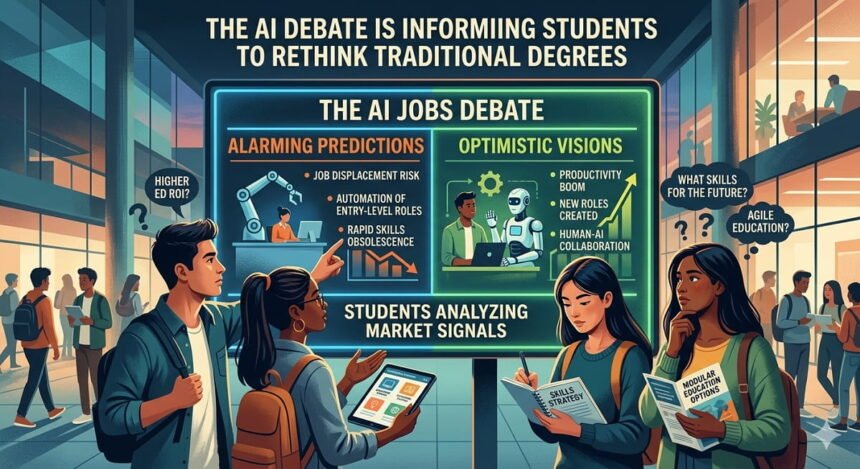
AI Jobs Debate: Artificial Intelligence is no longer a more casual technology discussed solely within research labs or at tech conferences. It has now become a daily reality in the workplace; it is influencing hiring decisions, reshaping job descriptions, and raising difficult questions about whether traditional degrees alone are sufficient to build an endless, long-term career.
This discussion takes place every evening in living rooms across India. A parent, while scrolling through social media, reads still another headline about AI Jobs replacing jobs; this time, the focus is on financial analysts. Meanwhile, their child is seeing over university program details, attempting to balance their parents’ expectations with the uncountable possibilities of the future.
AI Job Market
“What if I spend four years studying something that becomes outdated before I even graduate?” This fear is not baseless. The World Economic Forum’s 2025 Future of Jobs Report estimates that by 2030, AI will create 170 million new AI jobs, while 92 million existing jobs will be ended. For decades, the formula appeared simple: earn a degree, master a subject, and enter the job market. Today, that formula is under pressure.
Companies now increasingly prefer graduates who, rather than just having theoretical knowledge, can solve real-world problems, utilise digital tools, adapt rapidly, and collaborate effectively with intelligent systems.
Artificial Intelligence (AI) Is Reshaping Employer Values
The rise of generative AI tools, automation systems, and machine learning platforms has redefined the concept of employability for businesses. Employers are now seeking to determine whether graduates can efficiently utilise AI tools, interpret data, make decisions, and think critically in an environment where routine tasks are becoming increasingly automated.
Many entry-level tasks previously assigned to new graduates, such as preparing reports, creating presentations, sorting data, conducting preliminary analysis, and performing basic coding, can now be done immediately by AI systems. This does not indicate that jobs are disappearing completely; rather, it means that the very nature of graduate-level work is transforming. As a result, companies are now beginning to prioritise these skills:
| AI Literacy |
| Communication |
| Problem-solving Ability |
| Creativity |
| Ethical Judgment |
| Domain Understanding |
Adaptability This shift is particularly evident in fields such as finance, consulting, marketing, software development, healthcare administration, and operations management.
New Questions Arise Regarding Traditional Degrees
Traditional degrees still hold value today; however, their significance is now being assessed less based on qualifications alone and more on the basis of their actual outcomes. Employers are now asking several key questions:
+ Can a graduate apply their knowledge in real-world situations?
+ Can they work effectively with digital systems?
+ Can they quickly learn new tools?
+ Can they think beyond the answers provided in textbooks?
Degrees based on static curricula are facing criticism, as technology evolves at a pace far exceeding that of the syllabi at many universities. In some institutions, students are still studying frameworks that the industry has long since superseded. This disparity is becoming a major cause for concern among education policymakers.
AI Jobs: What Students Should Do Now
Students need not fear AI, but they do need to respond strategically. Experts suggest:
| Pursue your degree, but also add practical certifications. |
| Learn how AI tools function within your field. |
| Focus on internships and projects. |
| Create a digital portfolio. |
| Enhance your communication and analytical thinking skills. |
| Stay continuously updated. |
The future AI job market will reward learners who adapt faster than systems change.
Also Read: IIT Kanpur to Host Tech Startup Showcase ‘Abhivyakti 2026’ Starting March 20