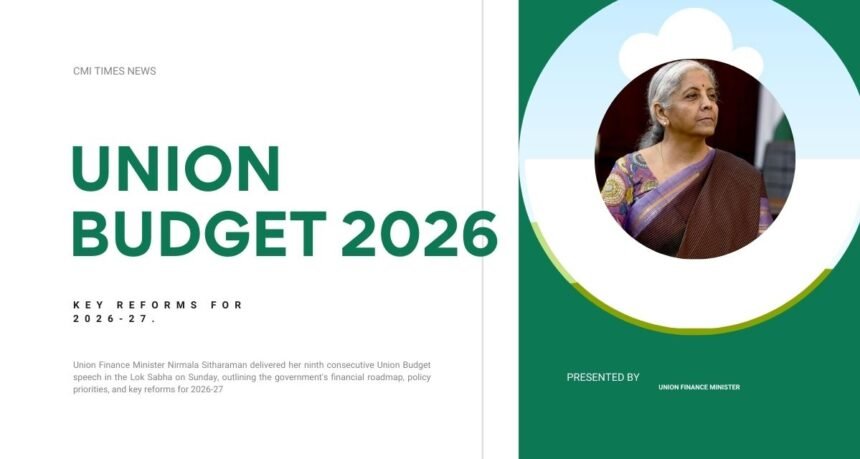
Union Finance Minister Nirmala Sitharaman delivered her ninth consecutive Union Budget speech in the Lok Sabha today (Sunday), outlining the government’s financial roadmap, policy priorities, and key reforms for 2026-27.
Her speech lasted 1 hour and 25 minutes, covering a wide range of sectors including taxation, infrastructure, financial institutions, healthcare, and social welfare, providing a comprehensive blueprint for India’s economic growth and development in the coming year.
Union Finance Minister Nirmala Sitharaman delivered her ninth consecutive Union Budget speech in the Lok Sabha on Sunday, outlining the government’s financial roadmap, policy priorities, and key reforms for 2026-27.

Union Budget 2026: Nirmala Sitharaman’s Speech
His speech, which lasted for 1 hour and 25 minutes, covered several sectors, including taxation, infrastructure, financial institutions, healthcare, and social welfare, outlining a comprehensive plan for India’s economic growth and development in the coming year.
Since we assumed power 12 years ago, India’s economic landscape has witnessed stability, fiscal discipline, sustained growth, and low inflation. This is a result of the deliberate decisions we have taken, even during times of great uncertainty and challenges. Our government, under the leadership of Honourable Prime Minister Modi, has consistently chosen action over rhetoric, reforms over empty promises, and the people over populism.
We have embraced far-reaching structural reforms, fiscal prudence, and monetary stability, while emphasising public investment. With self-reliance as our guiding principle, we have built domestic manufacturing capacity, enhanced energy security, and reduced dependence on critical imports.
Simultaneously, we have ensured that every government action benefits the citizens, implementing reforms to create jobs, boost agricultural productivity, increase household purchasing power, and provide universal access to essential services. These measures have resulted in a high growth rate of approximately 7% and have significantly reduced poverty and improved the lives of our people. These measures have resulted in a high growth rate of approximately 7%and have significantly helped us reduce poverty and improve the lives of our people.
Today, we face an external environment where trade and multilateralism are under threat, and access to resources and supply chains is being disrupted. New technologies are transforming production systems, while the demand for water, energy, and critical minerals is rapidly increasing.
India will continue to move confidently towards a developed India, maintaining a balance between ambition and inclusion. With a growing economy and increasing trade and capital requirements, India must also remain deeply integrated with global markets, export more, and attract stable long-term investments.
Also Read: MBA ROI: 30 Indian Colleges With the Highest Return on Investment