The central government has introduced a bill to replace the existing Mahatma Gandhi National Rural Employment Guarantee Act Scheme (MGNREGA) with a new employment guarantee scheme.
The central government will introduce the ‘Viksit Bharat, Employment and Livelihood Mission (Rural): VB-G RAM G Bill, 2025’ in the Lok Sabha, which, if passed, will replace the Mahatma Gandhi National Rural Employment Guarantee Act. According to sources, the NDA government will increase the number of guaranteed workdays under the new scheme from 100 to 125.
Discussions on the expansion of MGNREGA and renaming the act were underway in the Union Cabinet.
About MGNREGA
NREGA was implemented in 2005, and the then UPA government renamed it the Mahatma Gandhi National Rural Employment Guarantee Act on October 2, 2009. Under MNREGA, every rural household whose adult members are willing to do unskilled manual work is entitled to at least 100 days of employment in a financial year.
MGNREGA: From its inception to the present day
The Mahatma Gandhi National Rural Employment Guarantee Act (MGNREGA), commonly known as MNREGA, is one of the most ambitious social welfare programs in India’s history. It was designed to provide livelihood security to rural households by guaranteeing employment and strengthening rural infrastructure. Since its inception, MGNREGA has played a pivotal role in shaping rural employment, reducing poverty, and promoting social inclusion.
When and why was MGNREGA Launched?
MGNREGA was created by the Government of India in September 2005 and came into effect on February 2, 2006. It was implemented in a phased manner:
| 2006 | Launched in the 200 poorest districts |
| 2007 | Expanded to 130 more districts |
| 2008 | Implemented across the entire country |
The Core Objective: The main aim of MGNREGA was to
| + Provide at least 100 days of guaranteed wage employment per year |
| + Support unskilled manual work for rural households |
| + Reduce distress migration from villages to cities |
| + Create durable rural assets |
Key Features of MGNREGA:
The key features of MGNREGA include a legal guarantee of 100 days of unskilled work for rural households, employment on demand, payment of wages within 15 days (or unemployment allowance), mandatory inclusion of at least one-third women, prohibition of contractors, focus on creating productive assets, transparency through social audits, and joint funding by the central and state governments. It is not merely a welfare program, but a rights-based approach to livelihood security, ensuring accountability and empowerment.
| Mahatma Gandhi National Rural Employment Guarantee Act (MGNREGA) is unique because it is a legal entitlement, not just a welfare scheme. Major Provisions: + Any rural household can demand work + Employment must be provided within 15 days + If work is not provided, the worker is entitled to an unemployment allowance + Minimum wages are paid, linked to state wage rates + One-third of workers should be women + Worksites must provide basic facilities like drinking water, shade, and first aid |
Types of Work Under MGNREGA:
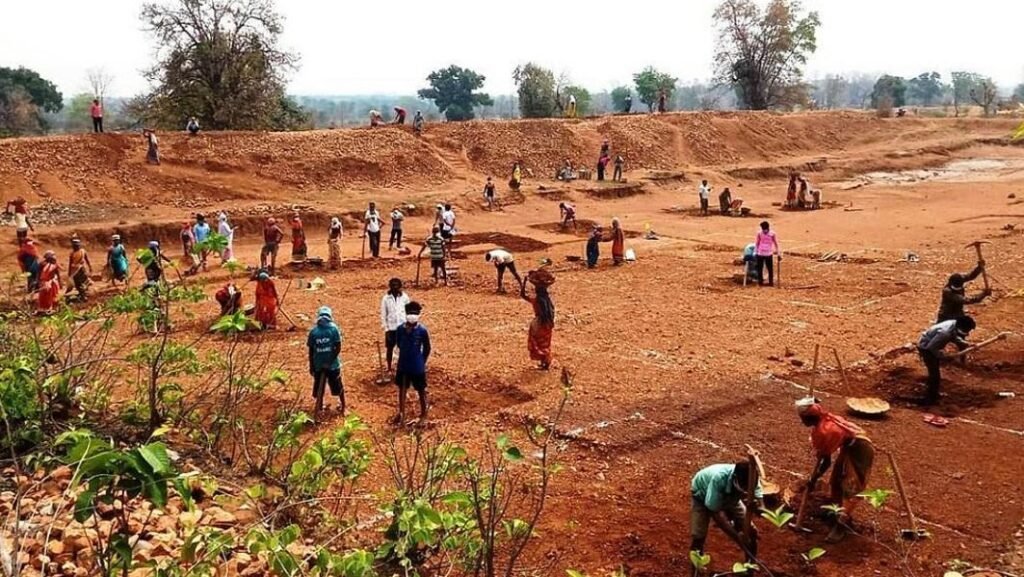
The works permitted under the Mahatma Gandhi National Rural Employment Guarantee Act are broadly categorized into four main areas, focusing on natural resource management, individual asset creation, and rural infrastructure. The scheme focuses on productive, community-based works, such as:
+ Water conservation and harvesting
+ Drought-proofing and afforestation
+ Rural road construction
+ Irrigation canals
+ Land development
+ Flood control and soil conservation
These works aim to improve long-term rural productivity, not just provide temporary income.
Women’s Participation
Women’s participation in the Mahatma Gandhi National Rural Employment Guarantee Act (MGNREGA) has consistently been high, often exceeding the mandated one-third requirement. In many years, women’s participation has surpassed 50 percent, leading to improved financial inclusion and decision-making at the household level.
Also Read: Union Cabinet Approves Bill to Replace UGC, AICTE, NCTE With a Single Higher Education Regulator