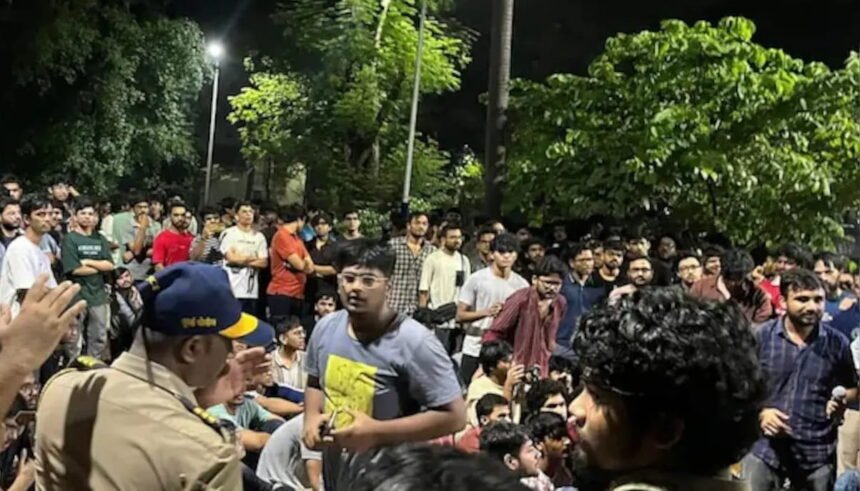
Across the country, student protests in 2026 expanded beyond issues of examinations and admissions to encompass broader aspects of university life. At IIT Delhi and IIT Bombay, students staged protests following the deaths of fellow students, demanding greater accountability and improved mental health support. At NALSAR and NLSIU, law students challenged decisions made by their universities and the judiciary.
Protests erupted at Jamia Millia Islamia over alleged irregularities in admissions, while students at Ambedkar University Delhi raised concerns regarding campus access, PhD regulations, and basic amenities.
In late September 2026, large-scale student protests and incidents of mob violence occurred at Lovely Professional University (LPU) in Phagwara, Punjab, and Chitkara University near Rajpura, triggered by unverified rumors circulating on social media. These separate incidents unfolded within a span of approximately 27 hours, resulting in widespread vandalism on campuses, clashes with the police, and the temporary suspension of classes.

Overall, these student protests signal a significant shift in student expectations regarding their institutions. While the specific disputes vary, they are increasingly converging on a single question: how do universities exercise their authority, and what can students expect when that authority fails to meet their expectations?
At IIT Delhi, students launched protests following the death by suicide of Rishikesh Kumar, a 31-year-old MSc Physics student, in August 2026. More than 500 students gathered inside the lecture hall complex, while approximately 2,000 others assembled outside. Students demanded an impartial inquiry, accountability from institute officials, and financial assistance for Rishikesh Kumar’s family. They also voiced broad concerns regarding student mental health and the support provided by the institute.
Subsequently, IIT Delhi constituted an external inquiry committee to investigate the circumstances surrounding Rishikesh Kumar’s death. When students continued to press for a more impartial process, the institute reconstituted the committee under the chairmanship of Justice Mukta Gupta, a retired judge of the Delhi High Court.
The institute stated that it was also strengthening mental health support, including the appointment of counsellors, psychiatrists, and an external ombudsperson to address unresolved student grievances.
Student Protest at IIT Bombay
At IIT Bombay, students staged protests following the death by suicide of Sahil Wakode, a 20-year-old B.Tech student, in September 2026. The protest lasted three days, with students demanding an independent inquiry and greater institutional accountability.

The students submitted an 18-point charter of demands, calling for independent investigations into suicide cases, improved mental health measures, greater student participation in academic decisions, and changes to the institute’s grievance redressal and disciplinary systems. The demands also included the provision of 24/7 psychiatric facilities on campus.
Following discussions with the protesting students, IIT Bombay Director Prof. Shirish Kedare signed the 18-point charter and accepted the demands in principle. A plan for their detailed implementation was to be presented to the students at an ‘Open House’.
Student Protest at Law Universities
At NALSAR University of Law, over 400 students objected to the proposal for the Chief Justice of India to attend their convocation ceremony. Similar opposition was witnessed at NLSIU Bengaluru, where hundreds of students and alumni protested against a proposal to involve senior legal officials. Consequently, NLSIU cancelled its 2026 convocation ceremony.
Student Protest Jamia Millia Islamia
Students protested against alleged irregularities in the 2026-27 spot-admission process. While the university dismissed these allegations, four students were suspended and barred from entering the campus for staging a sit-in without permission.
Student Protest at IISER Pune
Students staged an indefinite sit-in over issues concerning student representation, mental health support, hostel restrictions, disciplinary procedures, and campus security. Following this, the institute discussed increasing counseling capacity and revising policies regarding hostels and common spaces.
Student Protest at Chitkara University and Lovely Professional University
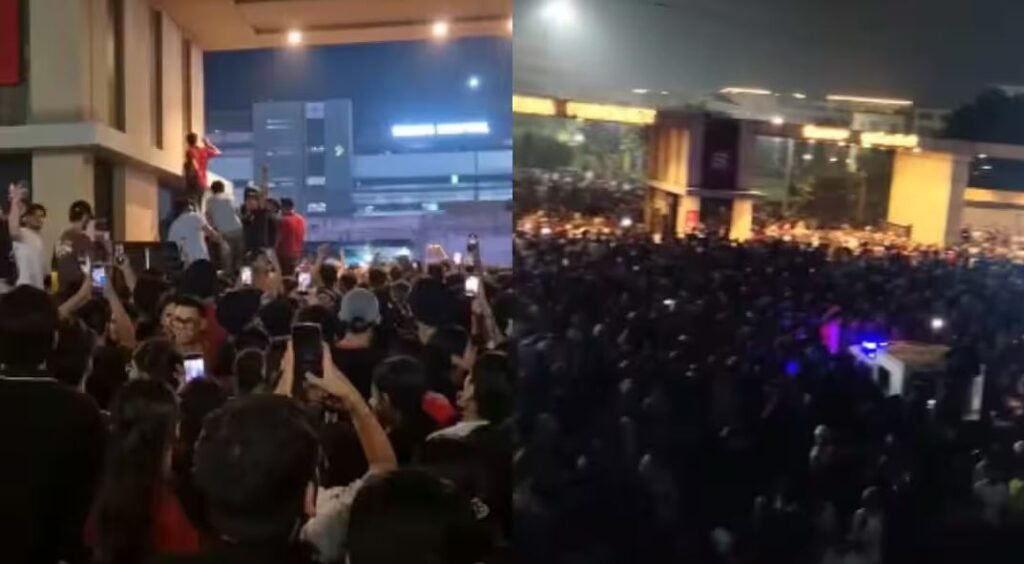
Student unrest was observed at both universities after shocking claims involving female students circulated on social media. The claims regarding Chitkara were found to be unsubstantiated, while the allegations at LPU were under investigation. These incidents highlighted the dangers of rumors spreading before the facts came to light.
Student Protest at Delhi University
Following an alleged gang-rape incident in Delhi, women and queer students staged protests and raised concerns about broader issues such as campus safety, unsafe commuting, stalking, and women’s freedom. Protests took place across several DU colleges and around the Faculty of Arts.
Student Protest at Ambedkar University Delhi
Students continued to protest over issues ranging from campus operations, access to facilities, PhD fees, and attendance regulations to the quality of amenities and research conditions. Subsequently, the university revised the attendance rules for full-time PhD scholars receiving fellowships.
Overall, while the immediate triggers for the protests at the university varied, they shared common concerns regarding broader issues such as student welfare, institutional accountability, academic freedom, safety, and the limits of university authority.
Also Read: IIT Bombay Student Suicide Update: Student Council Distances Itself from Protesting Group