

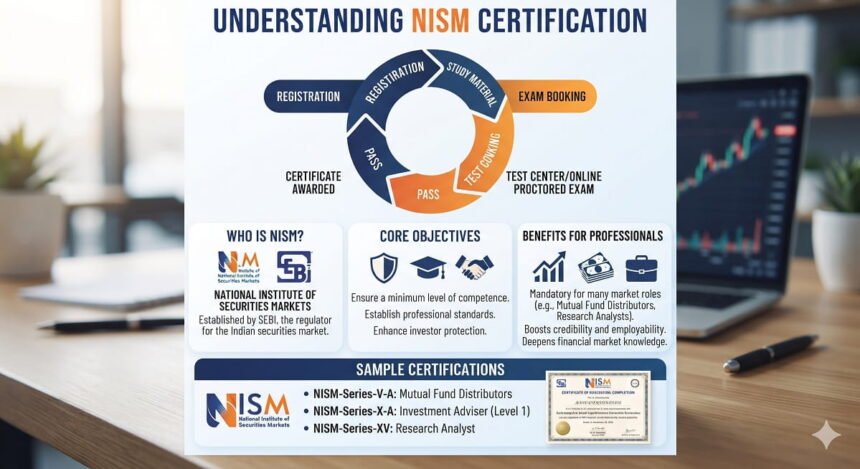
NISM Certification is a professional certification in the field of financial markets, securities, investment management, mutual funds, stock markets and financial advisory services. It is designed for students, graduates, working professionals and individuals who want to build a career in the Indian financial services industry.
The certification is offered by the National Institute of Securities Markets (NISM), an educational initiative established by the Securities and Exchange Board of India (SEBI) in 2006.
NISM certifications help candidates develop practical knowledge of India’s securities markets and prepare for professional roles in stockbroking, mutual fund distribution, investment advisory, research analysis, financial operations and compliance.
One of the major advantages is that students from different academic backgrounds can appear for NISM certification examinations. You do not necessarily need an MBA in Finance or a commerce degree to begin learning about financial markets.

1. What is NISM Certification?
NISM Certification is a series of professional examinations covering different areas of the Indian securities and financial markets.
These examinations assess candidates’ understanding of financial products, investment regulations, trading, mutual funds, derivatives, portfolio management and other specialised subjects.
NISM conducts mandatory and non-mandatory certification examinations. Certain certifications are required under SEBI regulations for individuals performing specified roles in securities market intermediaries.
For example:
> An individual working as a mutual fund distributor may require the NISM Series V-A certification.
> A person working in equity derivatives operations may need NISM Series VIII certification, depending on their role.
> Individuals pursuing research analyst roles should consider NISM Series XV.
> Candidates interested in investment advisory can explore NISM Series X-A and X-B.
Important: NISM certification is not a single degree or diploma. It is a collection of specialised certifications, each designed for a particular area of the financial services industry.
2. NISM Certification Course Details
NISM offers certifications in several areas of the financial markets. Candidates can select a certification depending on their career interests. Popular NISM certifications:
| Certification | Career Area |
| NISM Series V-A | Mutual Fund Distribution |
| NISM Series VIII | Equity Derivatives |
| NISM Series X-A and X-B | Investment Advisory |
| NISM Series XV | Research Analysis |
| NISM Series VI | Depository Operations |
| NISM Series VII | Securities Operations and Risk Management |
| NISM Series XII | Basic Securities Market Knowledge |
| NISM Series XVII | Retirement Advisory |
These are separate examinations, not different specialisations within one common course. The current NISM certification catalogue also includes specialised certifications in AIFs, PMS, merchant banking and other areas.
3. NISM Certification Eligibility Criteria
One of the biggest advantages of NISM certification is its open eligibility policy. According to NISM’s official FAQ, there is no minimum age or educational qualification requirement to appear for its certification examinations.
Who can apply?
| Students pursuing graduation |
| 12th-pass candidates |
| Graduates from any stream |
| MBA and PGDM students |
| Commerce, finance and economics graduates |
| Engineering and science graduates |
| Working professionals |
| Banking and insurance professionals |
| Individuals interested in stock markets and investment management |
| Entrepreneurs interested in financial services |
However, candidates should understand the difference between appearing for an examination and meeting the regulatory requirements for a particular professional role. Some regulated activities require additional educational qualifications, experience, registration or other conditions.
Also Read | Agniveers to Get Two More Years in the Army, but what comes next? Major questions remain

