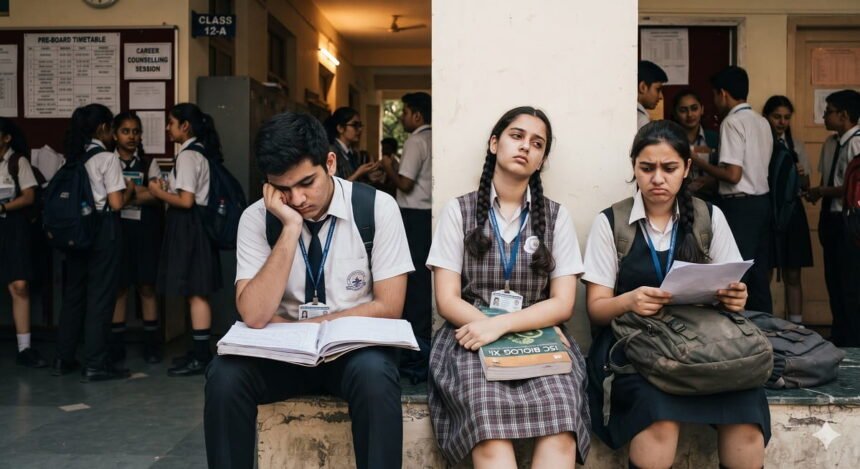
The data is in, and it paints a concerning picture of high school life today. A comprehensive survey conducted by the IC3 Institute, in collaboration with the Council for the Indian School Certificate Examinations (CISCE), reveals that 59% of Class 12 students are not satisfied with their school life.
For an education system long lauded for its academic rigor and its track record of producing successful alumni, this finding serves as a serious wake-up call. It forces us to confront a difficult question: are we measuring student success at the expense of their well-being?
To understand this dissatisfaction, one must examine the specific pressures faced by students in Class 12. This pivotal year is often viewed as a major hurdle, a defining phase that shapes a student’s future career path.
Caught between the relentless preparation for board exams, intense competition for entrance tests, and the heavy expectations of parents and society, students find themselves in an environment where performance is prioritized over their holistic development.
When schooling becomes synonymous with constant stress and perpetual comparison, the joy of learning vanishes, and students often end up completely burnt out.
This collaboration between IC3 and CISCE provides educators, school administrators, and policymakers with concrete evidence, a foundation upon which they can re-evaluate their priorities.
However, rather than viewing these findings solely as a crisis, they can also be seen as a catalyst for positive change. This collaboration between IC3 and CISCE provides educators, school administrators, and policymakers with concrete evidence, a foundation upon which they can re-evaluate their priorities. To address this dissatisfaction among 59% of students, merely organising superficial ‘wellness workshops’ will not suffice.
Schools must establish robust support systems for mental health, foster communities where students can openly discuss the challenges related to their studies, and redefine the very meaning of success, incorporating elements such as emotional resilience, creativity, and personal agency.
Ultimately, the purpose of education should not be limited to preparing young people to pass examinations; rather, it should empower them to navigate life and achieve success. If more than half of our senior students, who are currently in one of the most significant and energetic phases of their lives, feel dissatisfied or excessively stressed, then a transformation of our education system is essential.
By listening attentively to students and transforming the high school environment into a space defined by safety, collaboration, and a genuine curiosity for learning, we can change the situation, ensuring that academic success is accompanied by true fulfillment in life.
Also Read: JEE Main Registration Opens: Check Session 1 Dates and Eligibility Criteria