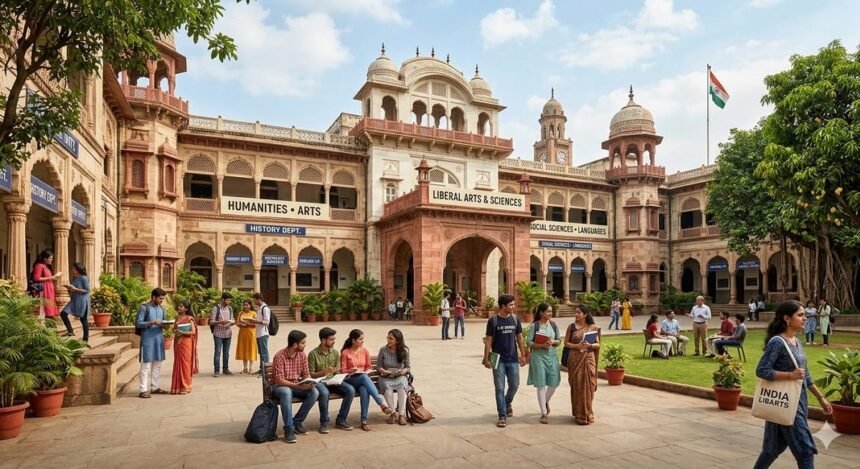
Liberal Arts Education: The rapid rise of generative artificial intelligence has sparked a predictable panic about the future of work. As algorithms write clean code, draft legal documents, and diagnose diseases, the traditional approach to career preparation has undergone a complete transformation. For years, the prevailing wisdom held that students should pursue highly specialised, deeply technical expertise.
But as AI commodifies technical execution, the focus has shifted away from the question of “how to build” and toward the questions of “what to build,” “why it matters,” and “who stands to benefit.”
In this new landscape, a liberal arts education, often wrongly disparaged as impractical, is now emerging as one of the greatest competitive advantages. Far from becoming obsolete, the humanities, social sciences, and foundational arts provide the exact cognitive framework required to thrive in an AI-driven world.

1. From “Answers Are Cheap” to “Questions Are Golden”
Generative AI tools are incredibly efficient at producing answers, but they are entirely dependent on the prompts they are given. They cannot independently identify a novel problem, question their own underlying assumptions, or understand the contextual nuance of human frustration. A liberal arts education is, fundamentally, an education in inquiry.
> The Socratic tradition trains the mind to unravel the layers of a problem, rather than simply accepting the surface-level truth.
> Literary analysis teaches students to read between the lines, to identify subtext, bias, and missing perspectives.
When one can generate a 1,000-word essay or a block of Python code in five seconds, the locus of value shifts from output to input. The individual who knows how to ask the right, incisive question will always outpace the one who merely knows how to copy and paste answers.
2. The Importance of Cognitive Agility
The shelf life of hard technical skills is shrinking. A programming language or data analysis tool that dominates today may well be automated by tomorrow. Professionals who tie their entire identity and skill set to a specific piece of software or a narrow technical task face the looming risk of being left behind in the next wave of automation. Liberal Arts graduates are trained for cognitive agility. They do not learn “what” to think; rather, they learn “how” to think.
| Educational Focus | Core Outcome | AI Resiliency |
| Hyper-Specialized Technical Training | Mastery of a specific current tool or process | Low (Highly vulnerable to algorithmic automation) |
| Liberal Arts & Sciences Foundation | Systems thinking, historical context, and adaptive learning | High (Easily pivots as the technological landscape shifts) |
By studying diverse subjects ranging from philosophy to biology, students cultivate profound mental frameworks that enable them to synthesise knowledge across various fields. Artificial intelligence lacks this same capacity for lateral thinking, making liberal arts graduates uniquely suited for roles requiring interdisciplinary oversight and strategic adaptation.
3. Ethical Stewardship in an Automated World
AI systems do not operate in a vacuum; they reflect, amplify, and encode human biases. As automated decision-making integrates into healthcare, criminal justice, and finance, the consequences of unexamined data are profound.
We do not just need engineers who can optimise an algorithm; we need thinkers who can evaluate whether that algorithm should be deployed in the first place.
“Technology without philosophy is blind; philosophy without technology is impotent.
“A curriculum rich in history, ethics, and sociology provides the necessary context to anticipate the societal impacts of technology. It forces us to grapple with questions of equity, justice, and human dignity, guardrails that a neural network cannot calculate.
4. The Irreducible Human Core: Empathy and Narrative
At its absolute best, AI is a mirror of existing human data. It can simulate empathy, but it cannot feel it. It can generate text, but it doesn’t understand the lived experience of grief, triumph, or systemic alienation.
| The liberal arts are a masterclass in the human condition. |
| History teaches us how societies fracture and heal. |
| Anthropology and Psychology reveal the underlying drivers of human behaviour. |
| Creative Arts trains us in the power of narrative and emotional resonance. |
In an economy flooded with machine-generated content, authentic human connection, storytelling, and deep empathy will become premium commodities. Leadership, negotiation, community building, and cross-cultural collaboration remain stubbornly and beautifully human.
The Synthesis: A New Educational Model
The argument is not that technical education should be abandoned, but rather that it must be married to the liberal arts. The future does not belong to the technologist who ignores the humanities, nor does it belong to the humanist who refuses to understand technology. The future belongs to the synthesisers.
As we hand over the routine tasks of calculation and execution to artificial intelligence, we are left with the most difficult, messy, and rewarding parts of being human. By leaning heavily into a liberal arts education, we ensure that as our machines become more capable, we do not lose our capacity to think for ourselves.
Also Read: UPSC Exam Concludes CSE Prelims 2026: Check Out This Year’s Questions for the GS Paper and CSAT