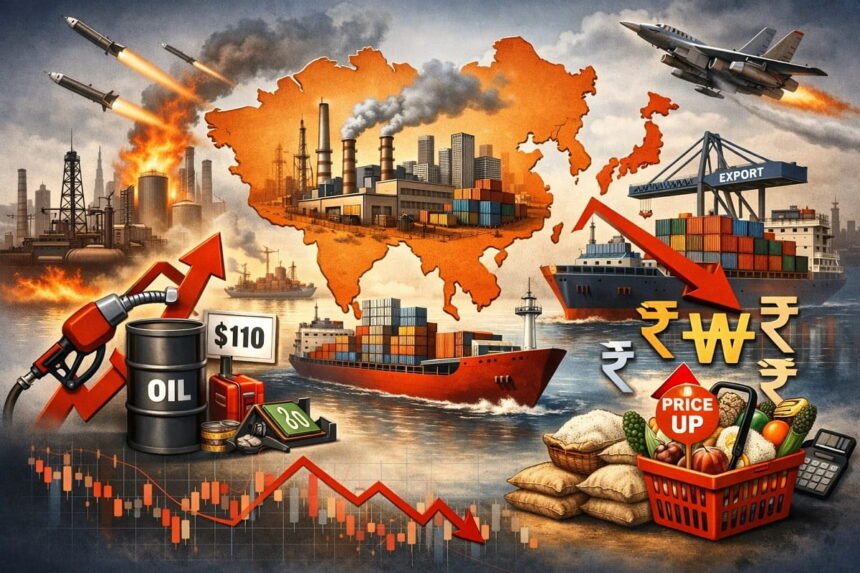
Reshaping Asia’s Economy: When war breaks out in the Middle East, the first instinct in most parts of Asia is not to look toward the battlefield, but rather to keep a close watch on oil prices. That is exactly what is happening right now.
The confrontation between the United States, under the leadership of President Donald Trump, and Iran has rapidly evolved into something far greater than a mere military standoff. It has now become an economic phenomenon, with repercussions extending far beyond the Gulf region itself. While bombs may be falling in West Asia, the immediate economic shockwaves are being felt in Mumbai, Shanghai, Tokyo, Seoul, Bangkok, and Jakarta.
U.S. and Israel’s War with Iran: How Reshaping Asia’s Economy
The reason is simple: Asia runs on imported energy, and a significant portion of this energy traverses a narrow maritime passage, the Strait of Hormuz. Approximately one-fifth of the world’s oil supply, along with a substantial share of global Liquefied Natural Gas (LNG), passes through this very route. Consequently, any threat emerging in that region instantly transforms into an economic crisis for Asia.
This time, the threat is not merely theoretical. Energy-related facilities in the Gulf region have already come under attack; the cost of insuring oil tankers is skyrocketing; and oil prices have surged past the $110-per-barrel mark, with prices climbing even higher whenever military tensions escalate.
For Asia, this entails more than just expensive fuel. It means inflation, pressure on national currencies, disruptions to manufacturing output, a decline in consumer demand, and a slowdown in the pace of economic growth. And since Asia now stands at the very epicentre of global manufacturing, whatever harms Asia does not remain confined to Asia alone.
Why does Asia Feel Every Shock so Much Sooner than Europe or the Americas?
Asia imports more energy from the Gulf nations than any other region. Japan sources the majority of its oil from the Middle East. South Korea is similarly affected. India imports most of its crude oil requirements. China, despite having diversified sources and strategic reserves, remains heavily dependent on energy supplies from the Gulf nations.
This means that every rise in crude oil prices immediately impacts daily economic activity. An increase in oil prices is not limited merely to the petrol pumps; it also has repercussions on:
+ Factory electricity bills
+ Fertilizer production
+ Transportation costs
+ Food freight
+ Airfare prices
+ Shipping contracts
In Asia’s export-oriented economies, this matters immediately because profit margins are often thin. A textile factory in Bangladesh, an auto supplier in Thailand, or an electronics manufacturer in Vietnam may not appear to be directly linked to the conflict in Iran; yet, all of them rely heavily on energy and shipping.
When energy costs rise, exported goods become more expensive. When shipping costs increase, delivery times become uncertain. When uncertainty mounts, buyers reduce their orders. This is how war infiltrates supply chains.
India’s Economic Situation is Particularly Precarious.
India’s vulnerability is exceptionally evident, as the country imports the majority of its crude oil while simultaneously striving to keep domestic inflation in check. When crude oil prices surge, India faces a confluence of three simultaneous pressures:
| First, the import bill escalates. |
| Second, the Rupee often weakens due to the increased demand for dollars required to purchase oil. |
| Third, inflationary pressures resurface, particularly in the transport and food sectors. |
Reshaping Asia’s Economy: Fuel Prices in India Impact Nearly Every Household
From a political standpoint, this is significant because fuel prices in India impact nearly every household.
+ Trucks laden with vegetables face higher diesel costs, which, in turn, drives up food prices.
+ The production costs for power plants that rely on imported fuel also rise.
+ Fertilizer manufacturers face increased input costs, which ultimately impacts the agricultural sector.
Even if the government attempts to cushion this shock by cutting taxes, doing so merely intensifies fiscal pressures elsewhere. India has begun considering providing war-risk insurance support for vessels engaged in trade with the Gulf region, as insurers are becoming increasingly wary of routes traversing conflict zones.
This fact alone underscores how quickly policymakers have grasped the gravity of the maritime risks involved. An even greater challenge, however, is the element of time. India had anticipated greater stability regarding imported inflation this year. A prolonged energy crisis, however, fundamentally alters that entire macroeconomic calculus.
Also Read: HDFC Bank Chairman Resigns on Ethical Grounds: What Happened, Why It Matters, and What Comes Next?