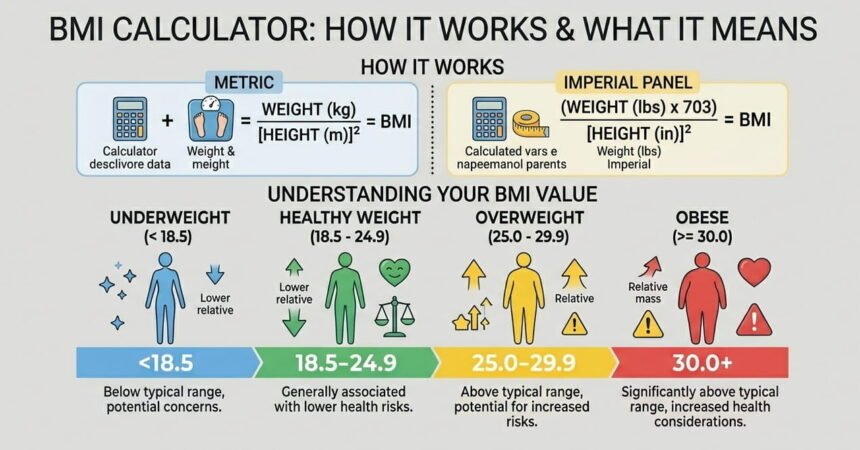
BMI Calculator Guide: Body Mass Index (BMI) is a method used to assess a person’s weight in relation to their height. The Body Mass Index, commonly referred to as BMI, is a simple numerical value used to determine whether a person’s weight is appropriate for their height. It helps doctors, fitness professionals, and the general public quickly identify whether an individual is underweight, at a healthy weight, overweight, or obese.
While BMI does not directly measure body fat, it serves as an excellent starting point for understanding a person’s overall weight status. Although BMI is not an exact measure, it remains one of the most widely used indicators in healthcare for screening for weight-related health issues. It is used to classify individuals into various categories: underweight, normal weight, overweight, or obese.

What BMI Means
BMI compares weight to height using a mathematical formula. Because taller people naturally weigh more than shorter people, the formula adjusts for height so the result can be compared fairly.
BMI Calculator: How to Calculate BMI
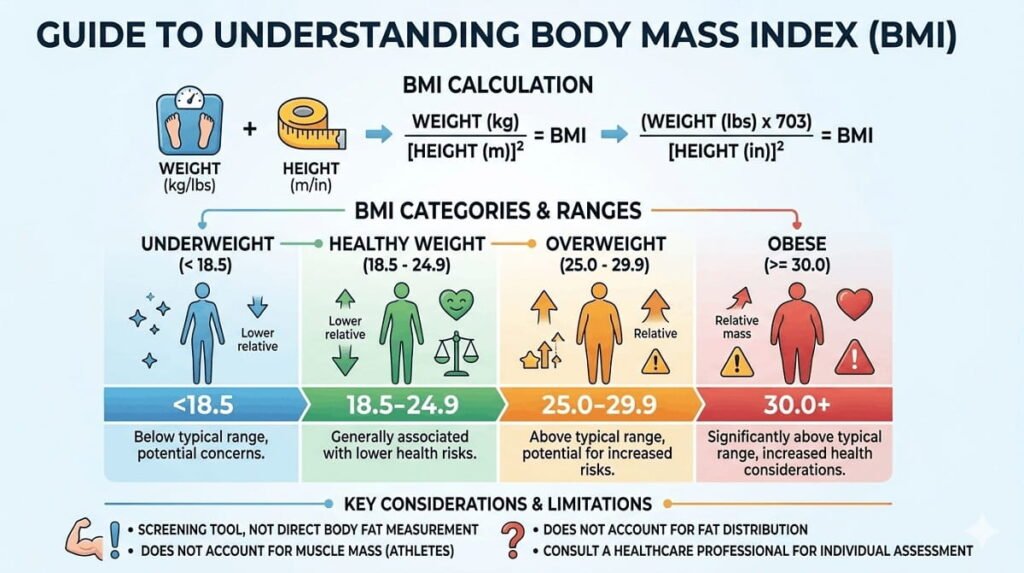
Calculating BMI is straightforward, provided you know your height and weight. Here is a step-by-step guide to calculating your BMI yourself: First, measure your weight in kilograms and your height in meters. The BMI Calculator formula is as follows:
BMI=weight (kg)/height (m)2
BMI=height (m)2/weight (kg)
| This Means: Weight should be measured in kilograms (kg) Height should be measured in meters (m) Height is squared before dividing Example Calculation: Suppose a person weighs 70 kg and is 1.75 m tall. First square the height: 1.75 × 1.75 = 3.06 Then divide weight by height squared: 70 ÷ 3.06 = 22.9 So the BMI is 22.9. |
The World Health Organisation (WHO) Defines these Categories as Follows:
| Underweight | BMI below 18.5 |
| Normal Waight | BMI between 18.5 and 24.9 |
| Overweight | BMI between 25 and 29.9 |
| Obese | BMI 30 and above |
BMI Calculator: Final Thought
Body Mass Index (BMI) should primarily be used as a screening tool, rather than for diagnosing a disease. A healthy lifestyle, waist circumference, level of physical activity, and medical history all these factors also matter.
Also Read: Africa to India via Dubai: The Full Story of Actress Ranya Rao ₹100 Crore Gold Smuggling Racket